Guide
Executive Monitoring: When CEO Coverage Hits the Board
Executive monitoring is a governance discipline, not a marketing one. Here's when CEO coverage crosses the threshold where the board needs to know.

Key points
- Executive coverage is not a marketing dataset. It is a governance signal. The right question is not whether the CEO is trending — it is whether coverage has crossed a threshold that changes what the board, the general counsel, or the regulator needs to know.
A general counsel I worked with — public company, mid-cap, the kind of audit committee that meets four times a year — once told me she had learned about the Wall Street Journal piece on her CEO from her teenage daughter. The daughter saw a screenshot on TikTok at 7:42 AM. The piece had run at 5:30. The board chair did not call until 9:15. By the time the audit committee was on a hastily-arranged call at noon, three institutional shareholders had already issued statements, and the question on the call was no longer "what do we say" — it was "why didn't we know."
Most discussions of executive monitoring start with the wrong question. They ask how to measure a CEO's reach, share of voice, or "thought-leadership" presence. The audit committee never asks about any of that. What it asks, when an executive's coverage starts to wobble, is something narrower and harder: did anything that happened today change what the board needs to know — and is there a record of when the company found out?
That second clause is the one that makes executive monitoring a governance discipline rather than a marketing one. Mention volume, personal-brand sentiment, and share-of-voice charts will not answer it. A different framework will.
Key insight
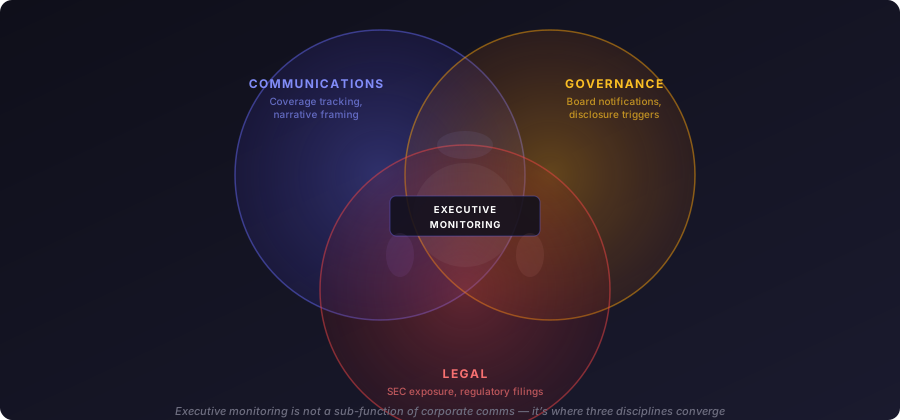
This guide is written for general counsel, corporate secretaries, chief communications officers, and audit committee chairs — the people who will be in the room when an executive coverage event becomes a governance event. I am going to set aside the personal-brand framing entirely. It is not that personal brand is unimportant; it is that it is not what makes executive monitoring a board-level concern.
What is executive monitoring, properly understood
Most tools that call themselves "executive monitoring" track volume, sentiment, and share-of-voice for a named executive. The implicit purpose is content strategy and personal-brand benchmarking. That is not what I am describing here.
In the governance tradition — the tradition that matters at the board level — executive monitoring is a reputation-intelligence practice: identifying, in something close to real time, when public information about a named executive has crossed a threshold that changes the company's obligations. Those obligations are concrete — internal escalation to the general counsel and CCO, formal notification to the audit committee, disclosure under SEC Item 5.02 of Form 8-K, and in some industries, parallel notifications to regulators or counterparties under existing covenants.
One tradition is a marketing function dressed up as monitoring. The other is a control function that happens to use monitoring tools. Confusing them is how boards end up surprised.
Why executive coverage is different from corporate coverage
There is a tendency, even among experienced operators, to treat executive coverage as a sub-component of corporate reputation tracking. The instinct is reasonable. The CEO speaks for the company; coverage of the CEO and coverage of the company sit on the same continuum.
The instinct is also wrong, in three specific ways.
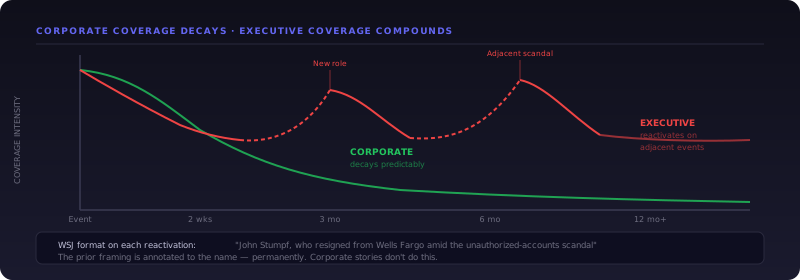
First, executive coverage attaches to a person, not an entity. A company can change its strategy, refresh its branding, divest a problematic line of business, and gradually rotate the press out of an old narrative. A person cannot do those things in the same way. The decisions an executive made — and the framing those decisions accumulated — follow that person across roles, across companies, and through any future regulatory inquiry. When journalists report on the next chapter of an executive's career, they reach for the previous chapter as context. Corporate stories decay. Executive stories compound.
Think of the difference between a car and a driving record. You can trade in the car — new color, new model, fresh start. Your driving record follows you to every new car, every insurer, every state. Executive coverage works like the driving record, not the car.
Second, executive coverage has a different decay function. Most corporate coverage follows a fairly predictable curve: a spike on the news event, decay over a few weeks, and then a long tail that is rarely reactivated unless a sequel emerges. Executive coverage, by contrast, gets reactivated by adjacent events — a new lawsuit, a new appointment, a new quote, a new comparable scandal — and each reactivation carries forward all of the prior framing. The Wall Street Journal does not write "John Stumpf, who was previously CEO of Wells Fargo." It writes "John Stumpf, who resigned from Wells Fargo amid the unauthorized-accounts scandal." The framing is annotated to the name.
Third, executive coverage interacts with regulatory and disclosure regimes in ways that corporate coverage often does not. Mention of an executive in connection with a federal investigation is itself a potentially material fact. A pattern of negative coverage that produces investor or counterparty concern can become a triggering event under change-in-control or the contract terms that trigger when something goes seriously wrong. Coverage that suggests the executive's continued service has become disputed at the board level is, in some circumstances, disclosable on its own. The corporate-reputation analogue does not exist.
The teams I have watched navigate this well treat the executive coverage feed as a different stream — with different thresholds, different escalation paths, and different review cadences — than the corporate feed. Mixing them, in my experience, produces the worst of both worlds: you over-react to vanity metrics on the corporate side and under-react to governance signals on the executive side.
Two different decay functions
Executive reputation risks the board actually cares about
Stripped to essentials, the board cares about a small number of executive reputation outcomes. They cluster into four categories.
The first is fitness to serve. Has anything emerged in coverage that would, if it were in front of the nominating committee at a fresh appointment, cause that committee to pause? This is the question that anchors the entire framework, because it maps directly to the board's ongoing fiduciary duty to oversee management. Coverage that touches integrity, judgment, or candor — not coverage that touches popularity — is the relevant input.
The second is operational drag. Is executive coverage starting to interfere with the things the company is trying to do — closing a deal, recruiting senior talent, retaining key customers, securing financing, navigating a regulatory process? An executive whose coverage has become a topic in every M&A diligence call is no longer a neutral asset to the transaction. An executive whose coverage is being raised in employee town halls is no longer a unifying figure inside the company.
The third is regulatory exposure. Has the coverage created, intensified, or broadened a regulatory line of inquiry? Coverage that names the executive in connection with an investigation, that quotes a regulator's concern, or that builds the public record a regulator will eventually rely on is a different thing than coverage that simply criticizes them.
The fourth is succession optionality. Has the coverage progressed to a point where the board's optionality on succession — the ability to make a planful, deliberate change rather than a reactive one — is starting to close? Once the coverage tips into "investors are openly speculating about replacement," the board's room to maneuver shrinks every day.
These four are the actual risks. Mention volume, share-of-voice, and personal-brand sentiment are, at best, weakly correlated with any of them. A CEO can have outstanding personal-brand metrics and a serious fitness-to-serve problem. A CEO can have flat sentiment and a worsening operational-drag problem. The dashboards do not tell the board what the board needs to know.
For a closely related discussion of why measuring tone misses the structural shifts that actually drive risk, see why narrative tracking is the missing monitoring layer.
Board-level reputation monitoring: the four-threshold framework
Once you accept that the right outputs are governance outcomes rather than vanity metrics, the inputs simplify considerably. There are not seventy KPIs to track. There are four thresholds, each with a defined trigger and a defined response.
I think of these as the tiers of monitoring built for the people who sign the disclosures — a phrase I use to distinguish what a board needs from what a marketing team wants. This kind of monitoring is the discipline of calibrating the watch to the duty: the board's duty is oversight of management, candor with shareholders, and timely disclosure of material change. The monitoring should produce signals against those duties, and nothing else.
The four thresholds of executive coverage
Each tier has a different trigger, a different response, and a different audience. The job of executive monitoring is to know which tier you are in. Click any tier for the named case I trace it back to.
- Tier 1
Routine coverage
Trigger: earnings commentary, conference appearances, expected media cycles, ordinary trade press. Response: logged, not actioned; reviewed in the weekly comms summary. Audience: communications team only.
- Tier 2
Comms escalation
Trigger: coverage outside the expected cadence — a national outlet asks an unscripted question, a critical opinion piece appears, a pattern forms across more than one source. Framing begins to attach a value judgment to the executive personally. Response: briefed to CCO and general counsel; holding statement drafted; source escalation tracked. Audience: CCO, GC, CEO; C-suite if the pattern persists.
- Tier 3
Board notification
Trigger: coverage touches one of the four board-level risks — fitness to serve, operational drag, regulatory exposure, or succession optionality. Often signaled by mainstream front-page placement, named regulatory interest, named investor concern, or the start of a 'what did they know and when' framing. Response: lead independent director and audit committee chair informed; pre-read prepared for next board meeting; external counsel engaged if the pattern continues. Audience: lead independent director, committee chairs.
- Tier 4
Disclosure consideration
Trigger: a material development concerning the executive — formal investigation, departure under negotiation, change to compensation or duties, credible allegation that, if substantiated, would be reportable. Covered explicitly under SEC 8-K Item 5.02 and parallel covenant or counterparty disclosure obligations. Response: disclosure committee convenes; materiality assessment documented; counsel determines reporting obligations. Audience: full board, disclosure committee, external counsel.
The same news event can sit in different tiers for different companies. Calibration to the executive's specific risk surface — regulatory exposure, deal pipeline, succession state — is the work.
The thresholds are not interchangeable, and they are not progressive in the sense that a story marches up the tiers in order. A single news event can land directly at Tier 3 or Tier 4 if it touches the right surface — a federal subpoena names the executive, an internal complaint becomes public, a regulator comments on the record. The job of monitoring is not to count mentions. It is to identify, as early as defensibly possible, which tier the situation has entered.
When executive coverage becomes a governance issue
The transition from Tier 2 to Tier 3 is, in my experience, the most under-managed moment in the entire executive-monitoring discipline. Tier 1 is well-handled because it is easy. Tier 4 is well-handled because the law forces the conversation. The middle is where the failures happen.
“Lose money for the firm, and I will be understanding. Lose a shred of reputation for the firm, and I will be ruthless.”
I will use a real example to make this concrete, because the abstraction does not do the work.
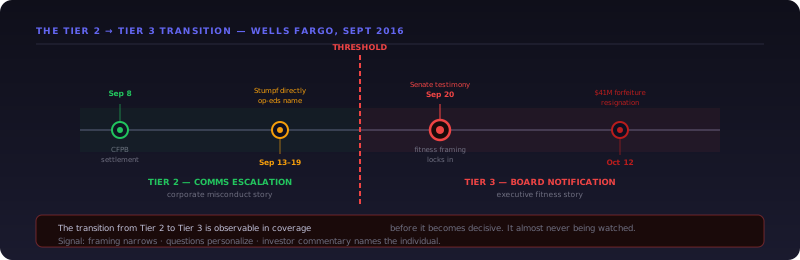
In September 2016, the Wells Fargo unauthorized-accounts scandal entered public view through a Consumer Financial Protection Bureau settlement. The company paid $185 million and the story was, initially, a corporate-conduct story. John Stumpf, then chairman and CEO, testified before the Senate Banking Committee on September 20, 2016. By the end of his testimony — under direct, sustained, and at times prosecutorial questioning from Senator Elizabeth Warren — the framing had moved decisively from a corporate-misconduct story to an executive-fitness story. The question was no longer what Wells Fargo had done. It was whether the man at the top had done what a CEO was supposed to do.
That is the threshold transition. From Tier 2 to Tier 3 is exactly that: the moment the story stops being about the company and starts being about the person. The signals were observable in the coverage well before the resignation. The framing had narrowed from "Wells Fargo's practices" to "Stumpf's practices." Op-ed columnists were calling for his removal by name. Investor letters were citing him as a specific liability. Stumpf retired on October 12, 2016, less than a month after the testimony, with forfeiture of more than $40 million in compensation — and the board's clawback action and the subsequent OCC consent order made clear, in retrospect, that the board had been weighing the decision against active coverage rather than ahead of it.
The lesson I draw from the case is not a critique of the Wells Fargo board — every board faces this in some form, and most are not dealing with senatorial cross-examination on national television. The lesson is structural. The transition from "this is a comms problem" to "this is a fitness problem" is observable in coverage before it is decisive. The framing narrows. The questions personalize. The investor commentary names the individual. By the time the board is handed a decision, those signals have been visible for days or weeks.
The Tier 2 → Tier 3 transition
A different example sharpens the point. In the period leading up to Bobby Kotick's eventual departure from Activision Blizzard, executive coverage went through a long, well-documented arc — from corporate-culture coverage, to executive-conduct coverage, to coverage in which large institutional shareholders began calling for his resignation by name. Each of those transitions corresponded to a different threshold tier. The point is not that monitoring would have changed the outcome. The point is that the threshold transitions were knowable, and the board's optionality narrowed at each one.
Cases like the Wells Fargo and Activision arcs are visible in retrospect. The harder discipline is identifying these transitions while they are happening. For a longer-form treatment of how a story's framing changes incrementally before any single event triggers escalation, see the Theranos narrative timeline — a case where the executive-fitness framing was visible in specialist coverage years before it landed in the mainstream.
Where the spokesperson fits in the four tiers
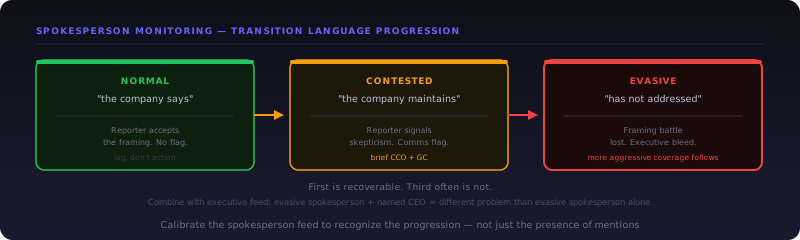
The designated spokesperson — usually the CCO, sometimes a non-executive board chair — sits inside the same framework but triggers differently. In normal operations, spokesperson coverage is Tier 1: logged, not actioned. In a crisis or investigation, the spokesperson becomes a person of record, and their coverage becomes a leading indicator of whether the executive tier is about to shift.
The tell is transition language. When reporters move from "the company says" to "the company maintains" to "the company has not addressed," the framing is hardening — and that progression almost always precedes more aggressive coverage of the executive the spokesperson is shielding. A spokesperson framed as evasive in coverage that also names the CEO is a Tier 2 signal on the CEO's feed, not just a comms problem. Tracking the two as separate streams misses the interaction; tracking them as one stream loses the granularity. The right approach is two streams read together.
The minimum practice: review the spokesperson feed against the company's actual public statements. A mismatch between what was said and how it was reported is recoverable. A spokesperson who is being characterized as evasive, contradicted by subsequent disclosures, often is not.
What fiduciary-grade monitoring actually requires
I want to close with what I mean by the term. "Fiduciary-grade monitoring" is the discipline of running an executive coverage feed in a way that the audit committee, the lead independent director, and outside counsel would, after the fact, accept as a reasonable system of oversight.
That is a higher standard than the marketing standard. It does not require expensive tools. It does require four things:
- A defined intake. The sources you watch, the cadence you watch them, how new sources are added when the executive's risk surface changes. This is the monitoring equivalent of Caremark — Delaware case law that says boards have a duty to monitor for red flags, requiring a documented information system, not just good intentions.
- A defined escalation path. Named recipients at each tier, written down where the feed is administered. Not "we will use judgment when something looks bad." The four-tier framework above, or a variant, with criteria for each transition explicit.
- A defined record. What was logged, what was escalated, what decision was made, on what date, by whom. The record is not for normal operations. It is for the day someone needs to reconstruct what the company knew and when. That day comes more often than people expect.
- A calibration to the executive's actual risk surface. Regulatory posture, M&A pipeline, succession state, ongoing investigations, prior controversies, public statements that could be revisited. A generic monitoring setup, calibrated to nothing in particular, produces generic noise.
The companies I have watched do this well treat executive monitoring not as a marketing function with a governance overlay, but as a governance function that uses monitoring inputs. The distinction sounds small. In practice, it is the difference between knowing what the audit committee needs to know — and finding out what they needed to know after the next 8-K is filed.
The vendor literature is not going to get you there. The four thresholds are a place to start.
What to put in place this quarter
If you are reading this and your company has none of this in place — which is most companies — three things are worth doing in the next ninety days, none of which require new tools.
Write down which executives are on the list, and why. Not all named executives need this kind of monitoring. Named executives in regulatory filings, the named executive officers in the proxy, the CEO's direct reports, and any spokesperson who is on the record in the company's name. For each, note one sentence on the specific risk surface — the deal in flight, the regulatory inquiry, the comparable scandal in the same industry that could be reactivated by a single tweet. The list should be three names, not thirty.
Put the four-tier escalation path on a single page, with named recipients at every transition. Tier 1 to comms; Tier 2 to CCO and GC; Tier 3 to lead independent director and audit committee chair; Tier 4 to disclosure committee. The page is for the day someone needs to reconstruct who knew what and when. Most companies discover, in that moment, that they had no page.
Schedule the first dry run. Pick a real news event from the last twelve months in your industry — not your own — and walk the four-tier framework through it. Where would it have triggered? Who would have been notified? What would the 8-K timing have looked like? The dry run will surface the gaps in your information system before a real event does. Caremark's standard is documented oversight, not perfect oversight. The dry run is the documentation.
The discipline is not exotic. It is, in my experience, the difference between a board that learns about a CEO story from its general counsel and a board that learns about it from its general counsel's daughter.
Related
pillar guide
Narrative Tracking: The Missing Layer in Monitoring
Sentiment dashboards watch tone. Media monitoring watches volume. Neither watches the story. Narrative tracking fills the gap that costs teams the most.
case study
Theranos: How Coverage Shifted to Fraud
Theranos looked healthy on every dashboard for two years. The framing in specialist reporting was already shifting 18 months before the WSJ blew it up.