Case study
Theranos: How Coverage Shifted to Fraud
Theranos looked healthy on every dashboard for two years. The framing in specialist reporting was already shifting 18 months before the WSJ blew it up.
Key points
- The Theranos collapse looks sudden in retrospect. The coverage record says otherwise. The framing shifted in 2015 — quietly, in named sources, in a few investigative pieces — long before the indictment, the trial, or the public consensus that the company had never worked.
In June 2015, Theranos was still a company Fortune had put on its cover. Elizabeth Holmes had been on the cover of Forbes the prior year as the youngest self-made female billionaire. The board carried the names you would expect of a national institution: Henry Kissinger, George Shultz, James Mattis, Sam Nunn. The company's valuation, on paper, was $9 billion. Walgreens was rolling out Theranos blood-draw centers in its stores.
“One of the things that contributed to making Elizabeth Holmes possible is this myth of the all-knowing, all-seeing startup founder.”
By October 16, 2015 — the day John Carreyrou's first Wall Street Journal investigation was published — almost none of the underlying facts about Theranos had changed in the previous six months. What changed, in the space of a single news cycle, was the frame.
I want to be careful about the punchline here, because it matters for what tools you choose to monitor crises like this one. The timeline of framing shifts in Theranos coverage predates the timeline of public belief shifts by roughly twelve to eighteen months. The signals were in the record. They were in named sources, in pulled-back press appearances, in specialist reporting from people who understood lab medicine. They were not in volume. They were not in sentiment. They were in the questions reporters had begun asking and the words those reporters had begun using.
Key insight
What follows is my reconstruction of how the Theranos narrative moved from "biotech disruptor" to "criminal fraud" — which sources moved first, which language changed when, and what was visible in the record before the public consensus caught up. There is no shortage of writing about Theranos. The angle I have not seen well-documented is the chronology of the framing rather than the chronology of the events.
How the Theranos story broke — and why it took so long
Most retrospectives treat the October 2015 WSJ piece as the rupture. The way I read the record, it was the consolidation of a fracture that had been opening for at least a year.
The earliest skeptical reporting that I have been able to find with named, on-the-record sources comes from late 2014 and early 2015. STAT News, Bloomberg, and a small set of specialist outlets had begun publishing pieces with experts in lab medicine — people like Eleftherios Diamandis at Mount Sinai Hospital — who were on the record with two specific concerns. The first was that Theranos had never published peer-reviewed validation data for its proprietary "Edison" device. The second was that the company's claims about running hundreds of tests on a single drop of blood were not consistent with any known progress in microfluidics (the technology of running medical tests on tiny amounts of blood) or shrinking lab tests to run on a single drop.
These pieces did not produce a volume spike. They did not move sentiment. They were, at the time, edge cases — a few skeptics in a sea of celebratory coverage. But they introduced a question that had not previously appeared in mainstream Theranos reporting: where is the data?
That question is what changed. Once it was in the record, the absence of an answer started to compound. Every subsequent profile that did not address it — and most of them did not — became part of the gap rather than the resolution.
Carreyrou, the Wall Street Journal reporter who would later write Bad Blood, has been clear in interviews that his reporting started with a tip from a pathologist who had read a flattering 2015 New Yorker profile and recognized that the science being described could not work. The reporter who would eventually break the story was reading the same coverage everyone else was reading and arriving at a different conclusion — because he had a source who could read what was missing.
Theranos media coverage before October 2015 — what dashboards saw
If you had been monitoring Theranos in conventional ways through the first half of 2015, the picture was uncomplicated.
Volume was steady and elevated by historical standards — the company was a recurring subject in business and technology coverage. Sentiment ran positive. Source distribution skewed mainstream and aspirational: Fortune, Forbes, Time, The New Yorker, Glamour, Vogue. Holmes was a regular on conference stages. The framing was consistent across these outlets: a Stanford dropout, a black turtleneck, a vision of democratized blood testing, a rare female founder in a male-dominated industry.
A dashboard summarizing this period would have shown a stable green column. The same dashboard, run on Boeing in late 2018, would have shown a similarly stable green column — and I have written about how that monitoring picture also missed what was actually happening. The pattern is not specific to Theranos. It is a pattern of what conventional monitoring is built to see.
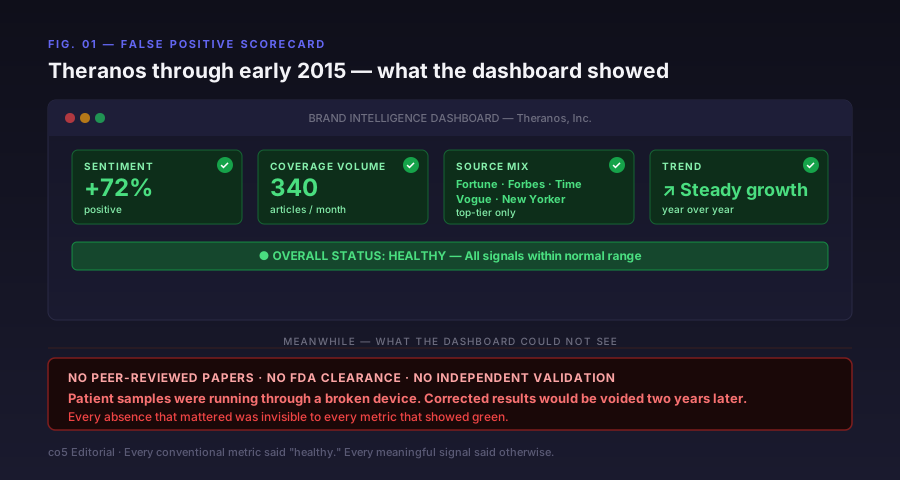
Every conventional metric said "healthy." Every meaningful signal said otherwise.
What it was not built to see, in the Theranos case, was three things.
The first was source composition. The aspirational coverage was in lifestyle and general-interest outlets. The skeptical coverage, when it appeared, was in specialist publications and industry trade press. A source-weighted view would have flagged that the celebratory frame was being built by outlets without scientific expertise and the questions were being asked by outlets that had it. That gap is information.
The second was the language of the early skeptics. In the period from late 2014 through summer 2015, the words "validation," "peer review," and "proficiency testing" started appearing in Theranos coverage. None of those words had been part of the prior framing, which was built on words like "disruption," "vision," and "genius." The introduction of vocabulary from regulatory science into a narrative that had been built on vocabulary from Silicon Valley was the framing shift, and it was happening months before the WSJ piece.
The third was the absence of voices that should have been present. By mid-2015, no major academic medical center had endorsed the Theranos technology. No peer-reviewed paper had been published. No competitor had attempted to validate the company's claims. Theranos was operating in the most regulated corner of medicine with none of the markers of regulatory legitimacy. That absence was a signal — and absences are precisely what aggregate sentiment cannot register, which is one of the reasons sentiment analysis fails as a primary monitoring tool during framing shifts.
The Theranos timeline — five framing phases
The phases below are the way I read the coverage record. Specific dates are anchors; the framing transitions are the substance.
Theranos coverage: five framing phases
From biotech disruptor to criminal defendant — how the frame changed in five distinct phases between 2013 and 2018
The transitions matter more than the dates. The disruptor frame held for roughly two years against a slowly accumulating set of skeptical pieces. It collapsed in a single news cycle in October 2015 because Carreyrou's piece consolidated those scattered concerns into a structured account with named former employees on the record. The fraud frame did not arrive with the WSJ piece — it arrived in 2016, when the Centers for Medicare & Medicaid Services sanctioned the Newark lab and Walgreens terminated its partnership. Once the regulator and the largest commercial partner had moved, the fraud frame became the default reading of the prior coverage.
The criminal frame was inevitable from that point. The SEC's civil charges in March 2018 and the federal indictment that summer were not new information for anyone who had been reading the coverage carefully. They were the legal system catching up to a narrative the press had already settled.
The narrative arc Theranos followed — and what it teaches
There is a four-phase pattern that shows up across reputation crises: isolated incident → product or process flaw → integrity question → systemic indictment. I have used it to describe Boeing. Theranos is unusual because there was no isolated incident. The framing arc had to be driven by reporting alone. There was no crash, no recall, no breach — only a slow accumulation of the question where is the data? and an eventual answer that the data did not exist because the device did not work.
That makes Theranos the cleanest test case I am aware of for what narrative-aware monitoring would have caught. Volume gave you very little. Sentiment was strongly positive through late 2015 and gave you very little. The signals were:
- Source composition. Celebratory coverage in outlets without scientific expertise; skeptical coverage in outlets with it. The mismatch was visible by mid-2015.
- Vocabulary inversion. Vocabulary from regulatory science (validation, peer review, proficiency testing) entering a narrative built on Silicon Valley vocabulary (disruption, vision). That linguistic shift was visible months before the WSJ piece.
- Conspicuous absences. No peer-reviewed paper, no academic medical-center endorsement, no independent validation in a category where all three would normally be present. Absences are signals; aggregations cannot detect them.
- Source escalation. Specialist outlets → WSJ front page → CMS sanctions → SEC → DOJ. Each step was visible before the next, and each step narrowed the company's room to maneuver.
I want to be precise about what this would and would not have done. It would not have predicted Theranos was a fraud. The internal facts of that determination required Carreyrou's reporting and, ultimately, a federal trial. What it would have done is registered, much earlier than volume or sentiment did, that the dominant celebratory frame was getting thinner — that the questions had changed, the vocabulary had changed, and the source mix had become inconsistent with what a healthy coverage profile for a healthcare-adjacent company looks like.
What narrative-aware monitoring would have caught
For a public-relations team inside Theranos, none of this would have changed the eventual outcome — there was no underlying technology to defend. For investors, board members, partners, and observers trying to read the company from the outside, twelve to eighteen months of additional warning is not a minor advantage. It is the difference between a graceful exit and being on the cover of the magazine the day it is announced that the lab license was revoked.
It is also worth being precise about what was happening on the ground during those eighteen months. Theranos was running real patient samples through the Edison device in Walgreens stores in Arizona and California. The company's own internal validation studies — surfaced years later in litigation — showed failure rates on certain assays that Theranos was nonetheless reporting to physicians as clinical results. Patients received corrected results in 2016 when the company voided two years' worth of test results from the Edison platform. Some of those tests had been used to diagnose conditions; some had not. The 12-to-18-month framing lag was not an abstraction. It was the period during which the public consensus held that the company was a triumph and the company was, in clinical fact, generating wrong answers about real patients' blood.
What early signals would have caught this
“We, the press, need to cover Silicon Valley with some skepticism and not take everything that these founders tell us at face value.”
A compressed view of what was visible in the record before the consensus shifted, organized by the kind of signal each represented.
Vocabulary signals. "Validation," "peer review," "proficiency testing," "single sensor," "no published data" — words that carry the credibility weight that comes from who is asking the question in regulatory medicine — start appearing in Theranos coverage in late 2014 / early 2015. The disruptor frame had used a different vocabulary entirely.
Source signals. Specialist pathology and lab-medicine outlets begin asking questions that mainstream business press is not asking. The mismatch between source tier and source expertise is itself a signal.
Absence signals. No peer-reviewed paper. No academic medical-center endorsement. No competitor validation. In a healthcare category, these absences are diagnostic.
Behavioral signals. Theranos's response to early skeptical reporting was to threaten litigation against sources rather than publish data. That response itself is a frame.
Source escalation. When skepticism climbs from specialist outlets into the WSJ front page in a single piece, the implied trajectory is toward regulators, then enforcement. Source escalation predicts consequence escalation.
None of these signals required predicting the future. They required reading the present carefully — and not flattening different kinds of coverage into a single sentiment score.
How Theranos compares to other reputation collapses
I have written about Boeing's narrative arc elsewhere. The key difference clarifies what makes Theranos unusual: Boeing had two precipitating crashes that drove the framing arc partly by events. Theranos had no precipitating event. The framing was driven entirely by reporting — no volume spike to catch, no crisis date to mark. That makes it the harder test for monitoring tools, and the cleaner proof that frame, source, and arc move before volume does.
Both cases moved through an integrity-frame transition, both ended with criminal exposure, and in both cases the early celebratory coverage did not become wrong — it became evidence. Competence failures are expensive. Integrity failures are existential. The transition between them is the part of the arc that monitoring tools, as currently built, are least equipped to see.
Key insight
The thing I want to leave a careful reader with is not a prescription. Theranos was an unusually clean case of a company that did not work pretending it did, and the consequence of that pretense was decided by a courtroom rather than a monitoring dashboard. What it offers is a record — a long, well-documented, publicly available record — of how a coverage frame moved from celebration to criminal defense, with all the intermediate stages preserved.
The frame moved before the consensus did. That is the part that is generalizable. The names change. The industry changes. The dynamic does not.
What I would do, on a quiet Wednesday, with a single hour
The closest thing to a usable habit I have drawn from the Theranos record is a small one. I run it on entities I cover the way someone might run a portfolio review.
First, read the last ten substantive pieces about the entity, in chronological order, and underline only the words that are new — words that did not appear in the prior coverage. Words from regulatory science showing up in a Silicon Valley story; words from medical practice showing up in a finance story; words from criminal procedure showing up in a corporate-strategy story. New vocabulary is a leading indicator. Track the rate at which it accumulates.
Second, identify the outlets and the bylines doing the new-vocabulary work, separately from the outlets doing the celebratory work. Plot them on a sheet of paper. If the new-vocabulary outlets are specialists and the celebratory outlets are general-interest, the gap is the signal. The signal is not in the tone.
Third, write down the questions the early-skeptic pieces are asking, verbatim. The questions are what the rest of the coverage will eventually answer. The answer arrives later than the question — sometimes by a year, sometimes by eighteen months. The question is what tells you which one is coming.
The exercise takes an hour. It will not predict any single event. It will, in my experience, register the framing lag earlier than every dashboard I have ever evaluated.
Related
case study
How Boeing's Narrative Shifted Before the Headlines
Boeing's 737 MAX narrative shifted from pilot error to cover-up over five months. Every transition was visible in the framing before it hit the numbers.
pillar guide
Why Sentiment Analysis Fails During a Reputation Crisis
Sentiment scores tell you how language sounds, not what the story means. During a real crisis, the tone stays calm while the story underneath gets worse.