Guide
Why Sentiment Analysis Fails During a Reputation Crisis
Sentiment scores tell you how language sounds, not what the story means. During a real crisis, the tone stays calm while the story underneath gets worse.

Key points
- Sentiment is useful as a secondary signal and dangerous as a primary one. In a reputation event, framing, source escalation, and stakeholder interpretation usually matter more than tone.
I do not trust a calm dashboard in the early phase of a reputation event.
That is not because numbers are useless. It is because the ugliest stories usually begin in language so measured it barely registers as danger at all. The clip is factual. The tone is neutral. The score is flat. The meaning has changed completely.
This is the trap sentiment dashboards set for communications teams. They are very good at sounding authoritative about the wrong question. They can tell you whether a sentence feels positive, negative, or neutral. They cannot tell you whether the story just shifted from routine coverage to an integrity problem, whether the wrong sources are starting to legitimize it, or whether the existence of a "positive" defense piece is itself the warning.
Key insight
That is the distinction that matters. If I am briefing leadership, I care less about whether the language got slightly darker overnight than whether the narrative got harder, more portable, or more consequential. A tone score can support that read. It cannot substitute for it.
The sentiment-reality gap
What the dashboard says vs what your team should actually do
Competitor recall mentions your brand favorably
Negative (-12%)
No action needed
Trade press questions your safety practices — neutral tone
Neutral (0%)
Narrative forming — act now
Industry-wide regulation names your company among 6 others
Negative (-15%)
Routine — matches baseline
Coverage shifts from 'product launch' to 'safety concerns'
Slightly negative (-3%)
Frame shift — major escalation risk
Same data, opposite conclusions. The dashboard can't tell the difference.
What sentiment analysis is actually good at
I am not arguing that sentiment analysis is fake, broken, or pointless. Used for the right job, it is perfectly respectable.
It works best when the emotional load of the text matches the strategic meaning of the text. Product reviews. Customer support tickets. Large pools of simple social commentary. A launch campaign where the question really is "did people like this or not?" In those contexts, sentiment analysis gives you a fast directional read, and a directional read is often enough.
It also helps when the audience question is genuinely aggregate. If leadership wants to know whether the public conversation around a consumer product is broadly warming or cooling over a quarter, sentiment can contribute something useful to that answer. The key word is contribute. It is one layer, not the verdict.
The problem starts when teams ask it to answer a much harder question: should I be worried about this story?
That is a reputation question, not a tone question. It is closer to diagnosis than measurement. The story may be calmly written and still be structurally dangerous. It may be loudly negative and still be operationally irrelevant. Once the decision on the table is escalation rather than description, sentiment stops being the lead instrument.
If you want the stack-level view of where sentiment belongs, I break that out separately in narrative tracking vs sentiment analysis vs traditional monitoring. The short version is simple: sentiment is one lens in a healthy system, not the system.
Why sentiment breaks down when the stakes rise
The failure is not primarily that the models are crude. The failure is that the question itself is too shallow for the job.
Reputation events are full of language whose strategic meaning depends on context, sequence, audience, and implication. That is exactly the kind of language sentiment systems flatten. Even the research on how computers read tone — including sarcasm detection — keeps landing in the same place: context is not a nice-to-have layer — it changes the interpretation entirely.
“It is not the severity of the crisis that determines the outcome. It is the perception of the response.”
That distinction — between what the language says and what the situation means — becomes a practical problem the moment a dashboard is used to make a judgment call. Three failure modes show up over and over.
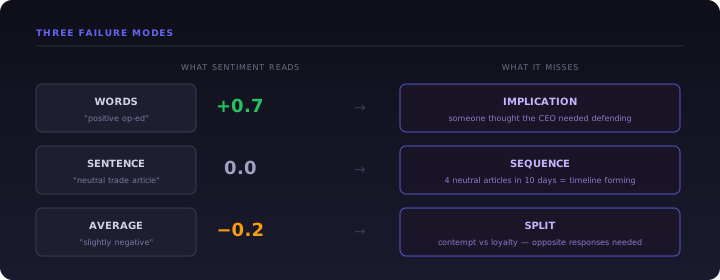
The score answers the surface question. The reputation question lives underneath it.
First, the score reads the words and misses the implication.
A positive op-ed defending an embattled CEO can be coded as positive. The words may well be supportive. The strategically relevant fact is that someone thought the CEO needed defending in public. When Wells Fargo's community banking scandal broke in 2016, early supportive statements from industry figures scored positive. What the sentiment dashboard missed was the implication: the story had become big enough that allies felt compelled to weigh in.
Second, the score reads the sentence and misses the sequence.
One neutral trade-press article about an operational issue may be routine. Four neutral articles in ten days, each adding one more missing fact, are not routine. Theranos followed exactly this pattern — months of calmly factual coverage from STAT News and the Wall Street Journal that built a timeline piece by piece. Sentiment saw a series of near-zero readings and reported nothing happened. The narrative was forming in public the entire time.
Third, the score reads the average and misses the split.
A polarized conversation can net out to "slightly negative" or even "neutral." That average is almost useless. When Bud Light faced its cultural backlash in 2023, the aggregate sentiment was "mildly negative." What that average concealed was a room split between active boycotters and loyal defenders — two audiences requiring completely opposite responses. A room split between contempt and loyalty behaves very differently from a room that is simply indifferent.
This is why I distrust the tidy confidence of sentiment dashboards in high-stakes situations. They present a surface reading with the visual grammar of certainty. A communications team under pressure can mistake that precision for understanding. It is not understanding. It is compression.
Why false alarms are not harmless
The standard criticism of sentiment tools is that they miss the real crisis. That is true. The quieter problem is what they do to a team in the months before the real crisis arrives.
Every company with real exposure has a background hum of negativity. Regulatory mentions. Industry-wide policy changes. A labor story that sweeps in six peer companies at once. A routine lawsuit that gets syndicated across regional business press. Sentiment tools dutifully count all of that negativity, and the dashboard turns amber often enough to make everybody tired.
That tiredness becomes organizational memory.
One false alarm is a nuisance. Five false alarms in a quarter start to train leadership that the comms team escalates too quickly. The meeting still happens. The brief still gets written. But the next time the team says, "This one is different," the room is slower to believe them. That is the cost sentiment tools almost never get blamed for: they quietly burn escalation authority.
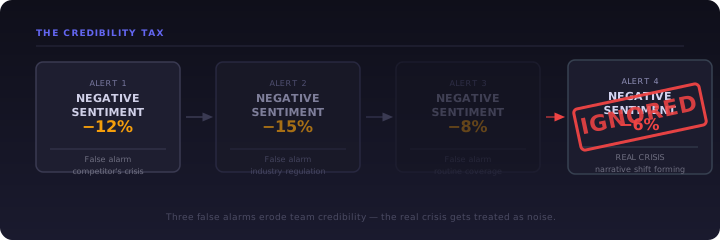
False alarms do not just waste time. They teach the room to distrust the next escalation.
I care about this because the comms team's internal credibility is part of the monitoring system. If leadership stops trusting the people reading the signals, the quality of the dashboard almost stops mattering. A weak model can still be survivable if the humans around it are trusted and skeptical. A sleek model paired with a room that has been trained to shrug is a more serious failure.
Why neutral coverage can still be the most dangerous coverage
This is the part sentiment systems handle worst, and it is the one I would insist every operator understands.
The most consequential early coverage in a reputation event is often written in a calm, factual tone. It is not trying to sound angry. It is trying to build a timeline, document a process failure, or pose a question whose implications will take another week to fully land.
That is exactly what happened in the early reporting around Boeing's 737 MAX crisis. The dangerous turn in the story was not a sudden burst of emotional language. It was a frame change — when the question the coverage is answering shifts from "what happened" to "what does this mean about the organization." The question moved from "what happened on this flight?" to "why was this system designed this way?" and eventually to "what did they know?" By the time Boeing was pleading guilty in 2024 to a fraud conspiracy charge tied to the MAX crashes, as Reuters reported, the emotional tone of the coverage had mattered far less than the story architecture built years earlier.
That is the kind of shift a sentiment dashboard routinely misses because the tone can stay almost eerily stable while the implications get much worse.
The costliest false negative
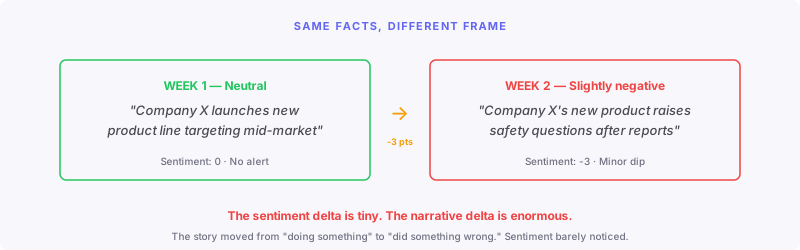
Tone can stay flat while the question underneath the coverage gets much more dangerous.
If I see neutral coverage begin to accumulate around accountability, safety, concealment, or leadership knowledge, I stop caring that the score is flat. The score is no longer the interesting fact. The interesting fact is that the story is becoming easier for more serious actors to carry forward.
That is where source escalation starts to matter. A calmly written story in the wrong trade publication can be much more dangerous than a loudly negative thread in the wrong corner of social media. Sentiment does not know the difference. It was never built to.
What sentiment scores flatten into one misleading average
Once a dashboard rolls coverage into a single line, four decision-relevant distinctions usually disappear.
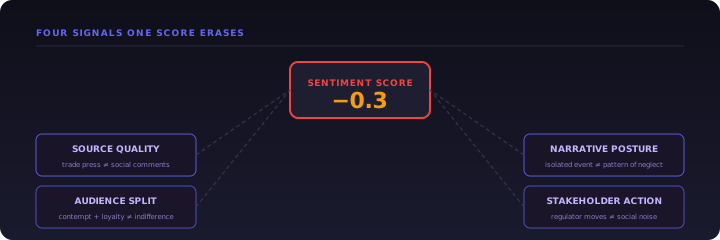
A single number cannot carry four different kinds of meaning. The signals that matter most are the ones it erases.
Source quality.
A skeptical note in Aviation Week and a swarm of sarcastic consumer tweets can produce a similar tonal average while carrying completely different consequence profiles. The Boeing 737 MAX story moved when specialist trade press started asking structural questions — not when social media got louder.
Audience interpretation.
The same piece of coverage can read as vindication to loyalists and confirmation of suspicion to critics. The mean score tells you almost nothing about the distribution of those reactions. When Johnson & Johnson pulled talc-based baby powder in 2020, loyalists read the move as proactive safety. Critics read it as admission. Same story, opposite interpretations, identical sentiment average.
Narrative posture (is this still an isolated event, or is it starting to imply a pattern?).
A story still attached to an isolated event is not the same as a story starting to imply pattern, negligence, or deception. The tonal vocabulary may overlap heavily. The strategic posture does not. Peloton's Tread+ safety recall in 2021 became an integrity question when reporting revealed the company had initially resisted the CPSC's warning — same measured language, fundamentally different story.
Stakeholder consequence.
If an investor, regulator, employee base, or partner group is likely to behave differently because of the coverage, I care. Sentiment does not measure that. It only measures the emotional surface of the text itself.
This is why I prefer to separate exposure from meaning whenever I brief a story. Sentiment can contribute to exposure context. It is a poor proxy for meaning. If the story is moving through the wrong sources, hardening into the wrong frame, or splitting the wrong audiences, the average tone score becomes one of the less interesting things on the page.
What I would track before I trusted the score
If sentiment is not the headline metric, what is?
I would still keep the score. I just would not let it go first. My order is:
-
Frame
What question is the coverage now answering? Is it still about an event, or is it becoming a question about judgment, culture, integrity, or concealment? When Volkswagen's diesel story shifted from "emissions test irregularity" to "defeat device", the frame change preceded the reputational collapse by weeks. The sentiment score barely moved until the language hardened. -
Source movement
Who is carrying the story now, and is it climbing? A new outlet tier matters more than another hundred low-value mentions. Wells Fargo's community banking scandal started in the Los Angeles Times and crossed into The New York Times and congressional testimony within months — a source escalation pattern that sentiment averages cannot detect. -
Stakeholder consequence
Which serious audience is likely to behave differently if this continues: regulators, employees, partners, investors, boards, customers? When Equifax disclosed its 2017 data breach, the FTC moved within weeks. The stakeholder consequence was regulatory, not reputational in the traditional sense — and sentiment was the wrong instrument to detect it. -
Audience split
Is the reaction converging or polarizing? An average can hide a fracture that becomes strategically decisive later. When Meta rebranded from Facebook in 2021, analyst sentiment and consumer sentiment diverged sharply — analysts saw a strategic pivot, consumers saw a distraction from platform safety concerns. The average was meaningless. -
Sentiment relative to baseline
Only here do I want the score, and even then I want it relative to the entity's normal pattern, not as a free-floating absolute. A 12-point drop on Tesla is Tuesday. The same drop on a sleepy B2B insurance brand is the entire crisis.
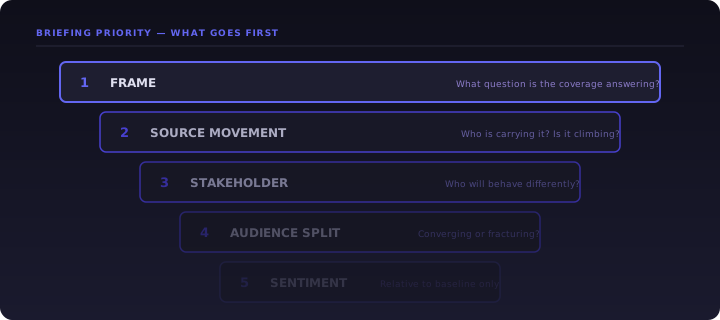
Sentiment belongs in the stack. It does not belong at the top.
That order forces the team to answer the right question first: what kind of story is this becoming? The score becomes supporting evidence rather than the first thing leadership sees.
This is also where the internal library starts to work as a system rather than a set of standalone posts. If the issue is tonal but not structural, sentiment helps. If the issue is structural, I want to know whether it is showing signs of frame change, whether it is climbing through source escalation, and whether it belongs in the broader category of narrative shifts unpacked in the Boeing case study.
Why this problem is about to get worse
There is a second-order effect of sentiment failure that most teams have not considered yet, and it concerns how large language models are beginning to shape institutional memory.
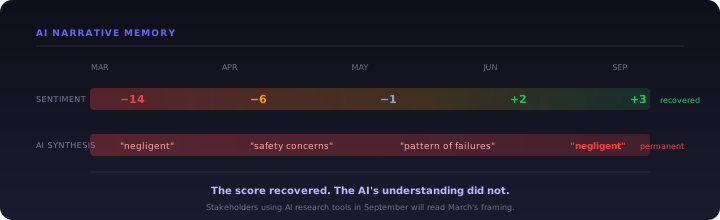
The score recovered. The AI's understanding did not. Stakeholders using AI research tools in September will read March's framing.
LLMs do not process individual articles. They absorb cumulative narrative. If months of coverage frame an organization as negligent — even in calm, neutral, factual language — the model's synthesis of that organization absorbs the framing. Your sentiment score might recover when the news cycle moves on. The AI's understanding of your brand will not.
This matters because AI-generated summaries, search overviews, and research assistants are increasingly how stakeholders — analysts, journalists, board members, regulators — form their first impression of an entity. Those tools are reading the same coverage your sentiment dashboard scored as "neutral." They are just reading it more carefully.
The implication is that the false negative problem is no longer bounded by human attention spans. A framing shift that sentiment missed in March can resurface in an AI-generated brief in September, long after the team assumed the story had passed. And here is where it lands on your desk: if you brief leadership using sentiment scores and an AI-generated research summary tells a different story, you will be the one explaining the gap.
How I would brief leadership without lying to them
This is the part I find most practical, because it changes behavior immediately and does not require new tooling first.
If I were writing the morning brief on a potentially sensitive story, I would not lead with "sentiment dropped 11 points overnight." I would lead with something closer to this:
- the dominant frame of the coverage right now
- what changed from the prior frame
- which source tier moved
- which stakeholder group is now more likely to care
- where sentiment sits relative to baseline
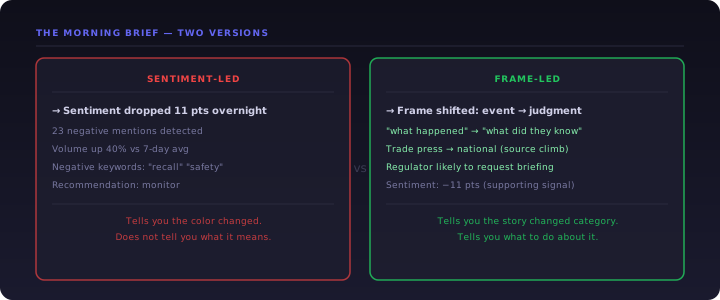
The brief on the left tells you the number moved. The brief on the right tells you what changed and who will care.
That order matters because it keeps the room from mistaking measurement for diagnosis.
Key insight
A good brief should help leadership understand what changed in the meaning of the story, not just what changed in the color of the dashboard. Once the room sees the problem that way, sentiment becomes easier to place correctly. Useful, but subordinate. Fast, but partial. Worth keeping, and not worth trusting alone.
That is my actual position on sentiment analysis. Not that it is worthless. That it becomes most dangerous in the exact moments people are tempted to trust it most.
Related
glossary
Sentiment Analysis in Reputation Work
Sentiment analysis scores whether text sounds positive, negative, or neutral. It is the metric most teams trust most and the one that misleads most often.
glossary
Frame Change in Reputation Monitoring
A frame change is when the question coverage is answering shifts — from 'what happened' to 'what did they know.' The vocabulary stays calm. The meaning moves.
glossary
Source Escalation in Reputation Monitoring
Source escalation is a story climbing the media ladder — from trade press to mainstream to political engagement. The direction matters more than the volume.
case study
How Boeing's Narrative Shifted Before the Headlines
Boeing's 737 MAX narrative shifted from pilot error to cover-up over five months. Every transition was visible in the framing before it hit the numbers.
comparison
Narrative Tracking vs Sentiment vs Monitoring
Three monitoring lenses answer three different questions. Teams that only ask one get burned in the seasons the others run quiet. Here's the comparison.