Guide
False Alarms vs True Escalation: A PR Guide
False alarms don't just waste time — they burn your credibility with leadership. Here's a five-check framework to separate noise from real escalation.

Key points
- False alarms are expensive because they train leadership to distrust escalation. The correct question is not 'is this getting louder?' but 'is this becoming more legible, more portable, and more consequential?' A five-check decision lens — source quality, frame severity, persistence, stakeholder proximity, and cross-channel velocity — separates noise from real escalation before the volume confirms it.
Monday morning. The dashboard is red. Slack is already moving. Someone has tagged the VP of comms with a screenshot of a sentiment chart showing a 40% volume spike overnight. An executive pings: "Are we aware of this?" The team scrambles. A brief is drafted. A call is scheduled. Two hours later, the spike turns out to be a competitor's supply-chain story that mentioned your company in a list of six. By noon it is over. By Tuesday nobody remembers it.
Except leadership does remember it. They remember they got pulled into a meeting for nothing. They remember the brief that sounded urgent and turned out to be irrelevant. They do not articulate this. They just become 15% slower to take the next escalation seriously.
That is the real cost of a false alarm. Not the two hours. The credibility.
Key insight
I have seen this pattern play out enough times to believe it is the single most underrated failure mode in communications monitoring. Teams worry about missing the real crisis. They should worry just as much about the false alarms that quietly make the real crisis harder to escalate when it arrives.
Why false alarms are more expensive than they look
The direct cost of a false alarm is obvious: wasted time, distracted leadership, a brief that goes nowhere. Most teams treat this as a nuisance. An acceptable tax on staying vigilant.
The indirect cost is structural, and it is worse.
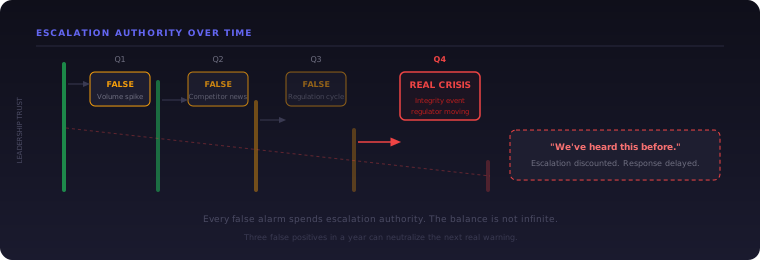
Three false positives in a year can neutralize the next real warning. The trust line only moves in one direction.
Every false escalation trains the room. The executive who was pulled into a meeting about nothing learns to add a delay before responding to the next alert. The general counsel who reviewed a brief about a non-event becomes harder to reach on the day the event is real. The board liaison who forwarded a warning that fizzled develops a longer threshold before forwarding the next one. None of these people will tell you this is happening. You will discover it when your next genuine escalation meets a two-hour response delay that did not exist six months ago.
The organizational memory of false alarms is longer than the organizational memory of correct ones. Nobody thanks the team for the three accurate escalations. Everybody remembers the one that wasted the CEO's Tuesday. This asymmetry is what makes alert fatigue a strategic problem, not an operational nuisance.
Research from Breznitz (1984) on cry-wolf effects in emergency systems documented the same pattern: repeated false alarms produce not just slower responses but qualitatively different responses — less commitment of resources, lower leadership engagement, and a shift from proactive containment to reactive observation. The dynamic applies identically to corporate communications teams.
What teams usually mistake for a crisis signal
The standard monitoring stack rewards exactly the wrong inputs for escalation decisions. I have watched teams escalate on three signals that are almost always misleading when used alone.
Volume. A mention count that doubles overnight is attention-getting and usually meaningless. Volume measures how many people are talking. It does not measure whether the conversation is going anywhere consequential. A celebrity tweet, an industry regulation announcement, or a viral meme can produce a volume spike that resolves itself within 24 hours. The question is not how many people mentioned you. The question is whether the mentions are converging on a frame that matters.
Negativity. A sentiment score that drops 15 points looks dangerous on the chart. As I wrote in why sentiment analysis fails during reputation events, the score reads the tone and misses the structure. Negative sentiment from social media commentators who have no institutional influence is a different animal from negative sentiment in trade press that a regulator reads. The number is the same. The consequence is not.
Alert count. The monitoring tool fires an alert. Then another. Then three more. The alert count feels like evidence of severity. It is usually evidence of the tool's threshold configuration. Most alert systems fire on absolute thresholds — any spike above X, any drop below Y — without accounting for the entity's own baseline. A noisy entity with a high-volatility baseline will trip those thresholds on an ordinary Tuesday.
The wrong inputs
The common thread: all three measure surface activity. None of them measure where the story is heading — whether it is climbing toward the kind of sources and audiences that can actually do something about it. A story that is getting louder is not necessarily getting more dangerous. A story that is getting more legible to institutional actors is.
How to separate noise, nuisance, and true escalation
I use three categories, and the distinction is not academic. Each one calls for a different action and a different level of internal communication.
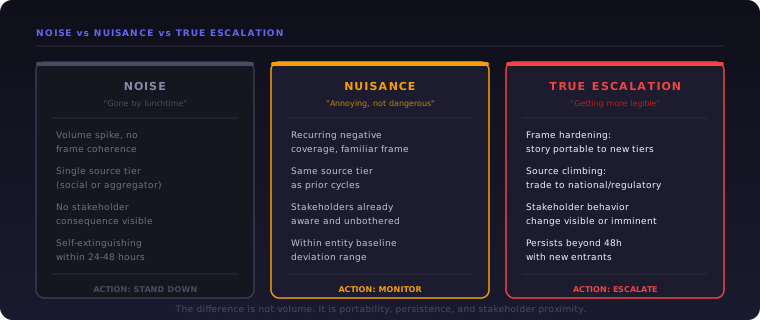
The difference between the three categories is not volume. It is portability, persistence, and who is paying attention.
Noise is a volume event with no structural coherence. The mentions are real, but they do not share a frame, they are not climbing through the source ecosystem, and no stakeholder with institutional influence is acting on them. The competitor-mention scenario from Monday morning is noise. So is a social media pile-on that burns out in 18 hours because the narrative has no institutional carrier. The correct action is to stand down and document why — both for the team's learning and for the credibility account. Every correct stand-down earns trust for the next real escalation.
Nuisance is recurring negativity within the entity's normal range. It looks concerning on the dashboard because the score is negative, but it is not structurally different from last month's version of the same story. A pharmaceutical company that operates in a politicized category will have a background hum of negative coverage about drug pricing or clinical trial controversies. That hum is the baseline, not the signal. The correct action is to monitor without escalating, and to keep leadership calibrated on what "normal" looks like for this entity.
True escalation has four characteristics that distinguish it from the other two: the frame is hardening (the story is becoming easier for a more serious actor to carry), sources are climbing (trade press to national, social to political), stakeholder behavior is changing or about to change, and the story persists beyond 48 hours with new entrants rather than recycled takes. When I see all four, I escalate. When I see three of four, I prepare the brief and watch the fourth. When I see fewer than three, I do not waste the room's time.
Five checks to run before escalating a PR crisis
Before I send a brief up, I run five checks. They take fifteen minutes. They save me from the false alarm that costs me the next real escalation.
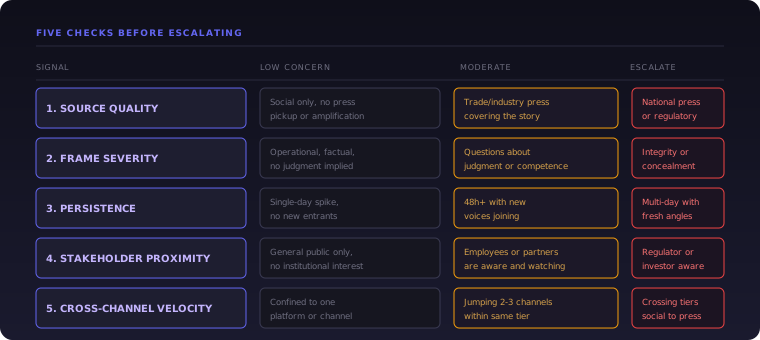
Five checks, fifteen minutes. If three or more land in the right column, escalate. If none do, stand down and protect your credibility for the day you need it.
1. Source quality. Who is carrying this story? Social commentary from general consumers is the lowest-consequence tier. Trade press that the entity's actual stakeholders read is the next tier. National press, wire services, or regulatory body publications are the tier that changes trajectories. When Boeing's 737 MAX crisis was building, the early reporting in trade publications like The Air Current and Aviation Week was more consequential than the social media outrage — because those outlets were read by the FAA, by airline safety officers, and by the congressional staffers who would eventually call hearings. The volume was small. The source escalation was the real signal.
2. Frame severity. What question is the coverage answering? Is it operational ("something broke"), or is it moving toward judgment ("why did they let this happen") or integrity ("what did they know")? This is the classification I borrowed from the first 90 minutes framework — the frame determines the trajectory more reliably than the tone. An operational story with a calm frame can be addressed with information. A story that is framing questions about concealment or negligence will not be resolved by a holding statement.
3. Persistence. Is this a single-day spike or a multi-day pattern with new voices joining? Noise spikes and fades within 24-48 hours. A genuine escalation picks up new entrants — fresh reporters, new outlets, additional angles that did not exist on day one. Silicon Valley Bank's 2023 collapse moved from a handful of venture capital Twitter accounts on Wednesday to a full-blown bank run by Friday, with each day bringing new institutional participants. That 72-hour persistence with new entrants was the escalation signal.
4. Stakeholder proximity. Which audiences with institutional power are now aware and potentially going to act differently? General public attention is important for brand perception over time, but it does not produce the sudden consequence-change that defines a true escalation. Regulatory attention does. Investor attention does. Employee mobilization does. When Equifax disclosed its 2017 data breach, the FTC moved within weeks. The stakeholder was not the general public reading about their compromised data — it was the regulator who could impose a $700 million settlement.
5. Cross-channel velocity (how fast the story jumps from one platform to the next). Is the story confined to one platform, or is it jumping channels and tiers? A Twitter pile-on that stays on Twitter is containable. A Twitter conversation that gets picked up by a reporter at The Wall Street Journal who then produces a piece that gets cited in a congressional letter has crossed three tiers in a week. The speed of that crossing is the escalation velocity. Balenciaga's 2022 campaign controversy crossed from social outrage to national press to celebrity disengagement to brand partnership cancellations in under five days — a cross-channel velocity that made it a genuine business crisis, not a social media nuisance.
“A signal that everybody in the office can see is not an early warning. It is a late one. The trick is recognizing the faint signal before it becomes loud enough to be obvious.”
The five checks are designed to be used together, not independently. A story that scores high on source quality but low on persistence is not yet an escalation — it is a watch item. A story that scores high on persistence but low on source quality is a nuisance, not a crisis. The escalation signal is when three or more checks move into the right column simultaneously. That convergence is what separates the real event from the dashboard noise.
Why a small story can be more dangerous than a big spike
This is the part that makes experienced comms people nervous, because it contradicts the instinct that big numbers mean big problems.
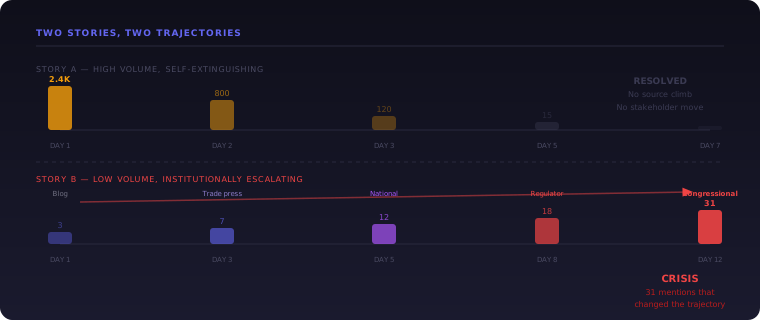
Story A is louder. Story B is more dangerous. Volume measures attention; source trajectory measures consequence.
A small story carried by the right validator is more dangerous than a large story carried by nobody consequential. The mechanism is simple: institutional actors do not respond to volume. They respond to legibility — can this story be turned into a regulatory action, a shareholder lawsuit, a congressional inquiry, an employee walkout? A loud social media pile-on is hard to legislate. A calmly written investigative piece in a publication a regulator already reads is easy to legislate.
Boeing's 737 MAX trajectory is the textbook example. The story that mattered was not the social media grief and outrage after the Lion Air crash, which was enormous. The story that mattered was the small body of trade press reporting that documented the FAA's delegation of safety certification to Boeing itself — a quiet, factual narrative that became the foundation for congressional hearings, a DOJ investigation, and a $2.5 billion deferred prosecution agreement. The trade press mentions numbered in the dozens, not the thousands. They changed the trajectory of a Fortune 50 company.
SVB's collapse in March 2023 shows the inverse: high velocity and high consequence. But what made SVB a crisis was not the Twitter volume per se — it was the speed at which the Twitter conversation crossed into institutional action. Venture capital firms advising portfolio companies to withdraw deposits was the stakeholder-proximity signal. The FDIC's Friday-morning closure was the confirmation. The volume was a symptom; the institutional behavior change was the cause.
The false alarm that does the most damage is the one that has volume but no institutional trajectory. It fires every alarm in the building. The team mobilizes. Leadership engages. And then nothing happens, because the story had no carrier with the power to make something happen next. The next time a quiet story starts climbing through trade press toward a regulator, the team hesitates — because last time they mobilized for a volume spike and looked foolish.
Volume creates attention. Consequence creates escalation. The discipline is knowing which one you are looking at before you spend your credibility on the answer.
How to build escalation judgment that leadership trusts
The framework above is a decision tool. But a decision tool only works if the organization trusts the person using it. Building that trust is a separate project.
Start by documenting the stand-downs. Every time you evaluate a spike and correctly decide not to escalate, write a one-paragraph note: what the signal was, what the five checks showed, and why you stood down. This creates a record. When leadership eventually asks "why didn't you escalate X," you have the analysis. More importantly, when you do escalate, you can say "I stood down on the last four — this one is different, and here is why." That sentence is worth more than any dashboard chart.
Brief in tiers, not in alarms. Instead of binary escalation (nothing or emergency), I use three tiers: "monitoring" (I see it, I am watching, no action needed), "watch" (the story is showing structural characteristics that could escalate, I will update in 24 hours), and "escalate" (leadership needs to make a decision). The monitoring and watch tiers are the investment. They train leadership to trust the tiered system. When the escalation tier fires, it carries the weight of all the times it did not.
Never lead with sentiment or volume in the brief. Lead with what kind of story this is and who is carrying it. "Trade press is asking questions about our compliance process and two outlets that our regulator reads have published" is an escalation-worthy lead. "Sentiment dropped 12 points and volume is up 300%" is noise disguised as precision.
Accept that you will sometimes be wrong. The alternative to occasionally calling a false alarm is never escalating, which is worse. The goal is not zero false alarms. It is a false alarm rate low enough that the next real escalation is taken seriously. Three false alarms in a year will erode trust. One false alarm in a year, with documented reasoning for the call, will not. The framework is a filter, not a guarantee.
The right question
The teams whose escalation calls leadership still trusts in year three are not the teams with the best monitoring tools. They are the teams that built a record of correct stand-downs, briefed in tiers instead of alarms, and led with structural analysis instead of sentiment charts. That record is the real monitoring system. The dashboard just provides the inputs.
I keep a version of the five-check grid printed next to my monitor. Not because I need it anymore — after enough cycles you internalize the pattern. I keep it there because the moment I stop using it is the moment I will escalate on volume alone, and that is the moment I start spending credibility I cannot get back.
Related
pillar guide
Why Sentiment Analysis Fails During a Reputation Crisis
Sentiment scores tell you how language sounds, not what the story means. During a real crisis, the tone stays calm while the story underneath gets worse.
editorial
5 Early Signals Before a Story Breaks
Stories don't break out of nowhere. Five precursor patterns are visible 72 hours before the headline — and the dashboard is built to miss all of them.
pillar guide
Crisis Response: A First 90 Minutes Framework
Most crisis playbooks start with a holding statement. The harder question — what kind of story is this — gets skipped. Here's a framework that doesn't.
glossary
Source Escalation in Reputation Monitoring
Source escalation is a story climbing the media ladder — from trade press to mainstream to political engagement. The direction matters more than the volume.