Guide
Crisis Response: A First 90 Minutes Framework
Most crisis playbooks start with a holding statement. The harder question — what kind of story is this — gets skipped. Here's a framework that doesn't.

Key points
- The first 90 minutes of a crisis are won or lost on understanding, not speed. A framework for the five decisions you have to make before anyone hits send — built around story type, baseline deviation, and opinion structure rather than reactive triage.
The first 90 minutes of a crisis are not a timer. They are a sorting problem.
Every framework you can find online treats them like a stopwatch. Fifteen minutes to acknowledge. Sixty to update. Ninety to brief the press. Same template, fifty blogs, same phone-tree diagram. I have used a version of that template myself. I have also watched it produce confidently wrong responses to events that turned out to be either much smaller or much bigger than the playbook assumed.
The thing nobody writes about — because it is harder to fit on a slide — is that the first decision in the first 90 minutes is not what do we say. It is what kind of thing is this. Get that wrong and every minute you save on the holding statement is a minute spent escalating the wrong crisis to the wrong people in the wrong tone.
Key insight
What follows is the framework I actually run. Five decisions, in order. Each one earns its place because skipping it costs you something specific later.
Why "issue a holding statement in 15 minutes" is not a framework
Let me be unfair for a moment. The standard advice — see PRSA's "5 Steps for Navigating the First Hour of a Crisis" for the canonical version — does useful things. Pre-drafted holding statements. Designated spokespeople. Pause scheduled content. A central point of coordination. None of that is wrong.
It is just not a framework. It is a checklist for executing a response you have already decided to give.
The decision you have already made — implicitly, the moment you hit the playbook — is that this is a crisis warranting a public response. That assumption is what breaks. Sometimes you are looking at a Reuters wire that mentions you in a list of six companies and the dashboard called it a crisis because the volume spiked. Sometimes you are looking at the actual integrity-event-that-ends-careers, and the playbook is telling you to send a 15-minute holding statement that will become the document everyone quotes back at you in the deposition.
A real framework starts one step earlier. Before what do we say, you have to answer is this what we think it is.
Decision 1 — Classify the story type before you classify the response
The single most useful thing you can do in the first ten minutes is name the kind of story you are looking at. Four categories matter, and they call for completely different first moves.
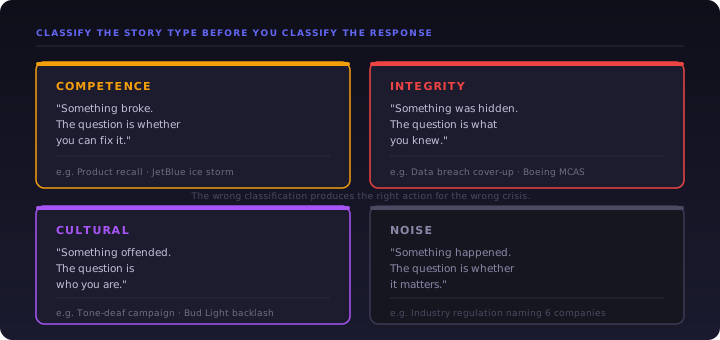
Competence event. Something failed. A product, a system, a service. The story is operational. The right early move is information — what happened, what's the impact, what are you doing about it. Holding statement is appropriate. JetBlue's Valentine's Day 2007 ice storm meltdown is the canonical version: planes stranded, customers furious, a CEO on national television within 72 hours saying "we did this to ourselves." Operational story, operational response, full apology. It worked because the classification was right.
Integrity event. The story is not what happened. It is what you knew. The right early move is do not issue the standard holding statement — because anything you say in the first 90 minutes that turns out to be incomplete becomes evidence of concealment later. Boeing's first-week response to Lion Air Flight 610 (the October 2018 crash that began the 737 MAX crisis, which eventually grounded the aircraft worldwide and produced criminal charges) followed the competence-event playbook for what turned out to be an integrity event. Five months of competence-framed statements later became part of the prosecutable narrative — eventually consolidated in the DOJ's $2.5 billion deferred prosecution agreement. The holding statement was on time. The classification was wrong.
Cultural event. The facts barely matter. The story is what your brand now signals, in a tribe that has decided to make an example of you. The right early move is not engaging on the terms the cultural channel is offering, because every engagement amplifies the imitation template. Bud Light's 2023 backlash is the lesson — by the time the CEO statement arrived on day fourteen, the meme template had been replicated for eleven days and the sales decline was structurally locked in. The statement could not have prevented the damage. It only re-platformed the conflict.
Noise. The dashboard is wrong. There is no story. The right early move is to stand down and not waste your team's credibility escalating something that resolves itself by lunchtime. This is the most common category. It is also the one nobody gets credit for getting right — even though every correct stand-down earns trust for the next real escalation.
The classification decision is not "does this feel bad." It is what kind of story will be told about this six weeks from now. If you cannot answer that in the first ten minutes, you are not ready to issue a statement.
Decision 2 — Compare the signal to the entity's own baseline, not to a generic threshold
This is the decision that separates teams who get pulled into every false alarm from teams who get listened to when they actually escalate.
The standard advice acts on absolute thresholds. Sentiment dropped 15 points. Mention volume tripled. Negative coverage in three top-tier outlets. Move. The problem is that absolute thresholds treat every entity as if it operates in the same noise environment, and they do not.
A 12-point sentiment drop on Tesla is Tuesday. They live in a constant low-grade negativity from short-sellers, EV-skeptic press, and a politically inflamed CEO. Their baseline already absorbs that. The same 12-point drop on a sleepy B2B insurance brand whose baseline is 95% trade-press neutral is the entire crisis. Same number. Different signal.
Deviation, not absolute score
This is why sentiment thresholds without context produce confidently wrong escalations. The number is not the signal. The deviation from the entity's own normal is. In the first 30 minutes I want two readings: where is this entity's score now, and how far is that from where the entity sits on an average week. If the answer is "two standard deviations below baseline," I escalate. If the answer is "within one standard deviation," I do not — even if the absolute number looks ugly.
The corollary nobody likes: this means you have to know the baseline before the crisis. You cannot construct a baseline at 9 AM on the day the story breaks. The teams that respond well already had this number on file. The teams that do not are reverse-engineering it during the only ninety minutes they cannot afford to spend on math.
Decision 3 — Read the opinion structure, not just the average
This is the decision that gets skipped most often, and it is the one that most often determines whether the response makes the situation worse.
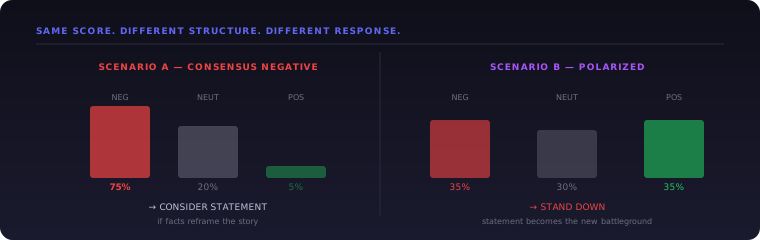
Average sentiment is a single number. It hides everything that matters about the shape of the conversation. Two scenarios produce identical sentiment scores and require completely different responses.
Scenario A. Coverage is uniformly negative. Wires, trade press, social — all converging on the same critical frame. The question is how do we change the frame. A statement may help if it introduces new information that legitimately reframes the story.
Scenario B. Coverage is split. Half the outlets are critical, half sympathetic, the social conversation is polarized 35/30, with a lawsuit driving the negative and a loyal customer base driving the positive. The question is not how do we change the frame. It is do we get involved at all. Issuing a statement in a polarized conversation collapses both sides onto your statement as the new battleground. You do not change minds. You give both tribes a fresh artifact to fight over.
The two scenarios produce a similar sentiment chart. They demand different actions. Most dashboards will not surface the difference; you have to look for it. Before you draft anything, look at the distribution: what percent positive, neutral, negative — and is that distribution unusual for this entity. Polarized coverage on a polarizing brand is not news. Polarized coverage on a brand that usually sits at 70% neutral is a structural change worth understanding before you intervene.
Bud Light is again the clean illustration. Polarized cultural conversation, brand issues a centrist statement aimed at neither tribe, both tribes treat the statement as evidence of betrayal, the statement becomes the new artifact people fight about.
Decision 4 — Decide who owns the call before you draft anything
In the first 60 minutes, you need a written answer — not verbal, written, with names — to four questions: Who approves the public response (one name, not a committee). Who is the spokesperson on record. Who briefs the board, and on what trigger (define the trigger in writing — not "if it gets bad"). Who does not speak publicly under any circumstances.
This feels bureaucratic and the clock is loud. It is non-negotiable because ambiguity in a crisis is a vacuum, and vacuums get filled by whoever is most confident in the room — which is almost never the person who should be making the call.
For executive-related events, the board notification threshold becomes its own framework. General counsel should be in the document by minute 30 — the SEC's 8-K Item 5.02 disclosure rules start a four-business-day clock at the moment of board awareness, and "we did not realize the threshold had been crossed" is not a defense.
Decision 5 — Choose a posture; defer the words
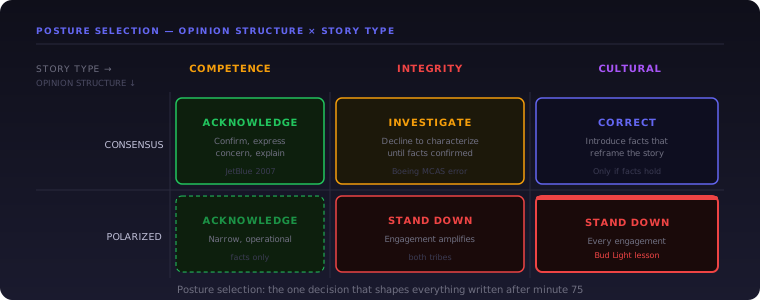
By minute 75 you should know what you are doing. The actual statement, if there is going to be one, falls out of the posture — not the other way around.
Four postures, not interchangeable.
Acknowledge. You are confirming the situation exists, expressing concern, and saying you are looking into it. The holding-statement default. Use it when the classification is competence, the baseline deviation is real, and the opinion structure is consensus.
Correct. You are introducing specific, verifiable facts that contradict the dominant narrative. Use this only when you have hard facts and a credibility account large enough to spend. If the correction turns out wrong, you have spent the credibility account and added a new chapter.
Investigate. You are explicitly declining to characterize the situation until you understand it. The right posture for integrity events in the first 90 minutes. It looks weak. It is the strongest posture available to you because it is the only one that does not lock you into a story you may not be able to defend in the deposition. Boeing's mistake was not silence. It was characterization without confirmation.
Stand down. You do not respond. The story is small, the baseline deviation is within range, the opinion is fragmented in a way that means engagement amplifies. The hardest call when leadership wants to "do something." Your job in that moment is to remind them that doing nothing is a thing, and frequently the right thing.
Think of it like answering the front door to a stranger. "Acknowledge" is opening the door and saying, "I see you, let me find out what this is about." "Correct" is handing them a document proving they have the wrong house. "Investigate" is saying, "I am not going to answer until I know who sent you." "Stand down" is looking through the peephole, deciding it is a flyer delivery, and going back to dinner.
“The single biggest predictor of loss of trust in a crisis is the perception that you don't care.”
This is the tension the posture choice has to hold. Standing down when you should acknowledge reads as indifference. Acknowledging when you should investigate reads as premature characterization. The posture is the load-bearing decision. Once you have chosen one, the words mostly write themselves — and they should be drafted by someone who was not in the decision meeting, so they are written for the audience and not for the room.
Posture first, words second
The 90-minute checklist, in the order I actually run it
Here is the compressed version, for the document you tape to the inside of the war-room door.
First 90 minutes — decision sequence
Five decisions, in order. The clock starts the moment someone says the word "crisis" out loud. Do not let the playbook sequence ("acknowledge in 15") override the decision sequence below.
- 0–10
Classify the story type
Competence, integrity, cultural, or noise. The wrong classification produces the right action for the wrong crisis. If you cannot answer this, you are not ready to draft anything.
- 10–30
Check the deviation from baseline
Not the absolute score. The deviation from the entity's own normal. Two standard deviations is real. Less is probably not. If you do not have the baseline on file, that is the bug to fix this quarter.
- 30–45
Read the opinion structure
Consensus negative or polarized. Different conversations, different responses. A statement in a polarized conversation collapses both sides onto your statement as the new battleground.
- 45–60
Lock the decision rights in writing
Approver, spokesperson, board-notification trigger, do-not-speak list. One document, named names, no committees. Ambiguity gets filled by whoever is loudest, not whoever is right.
- 60–90
Choose the posture, then draft
Acknowledge, correct, investigate, or stand down. The posture decides the statement. Do not let the statement decide the posture. Drafting is done by someone who was not in the meeting.
A 90-minute decision sequence built around classification and baseline rather than a fixed acknowledge-update-brief timer.
Common mistakes in the first 90 minutes of a crisis
A few prohibitions, earned the hard way.
I would not put the CEO on camera unless the classification is unambiguously competence and the facts are confirmed. Cameras are irreversible. The instinct to "show leadership" within the first hour is, in integrity events, almost always the instinct that produces the clip the prosecutors play.
I would not promise a timeline I cannot defend. "Updates as we know more" is a sentence. "We will have a full statement within four hours" is a contract. Do not write contracts you have not read.
I would not use the word "transparent" unless I can specifically describe what I am being transparent about. Generic transparency claims in the first 90 minutes set a bar you will fail to clear, and the failure becomes the story.
I would not engage on social platforms in a polarized cultural event, no matter how much it itches. The platform is the amplifier. Every engagement is fuel.
What this framework will not do for you
It will not save you from a real crisis. The Boeing 737 MAX disaster killed 346 people; no framework reverses that. The framework is for the smaller question of whether your response adds to the damage or limits it. That is the question your team controls.
It will not save you from leadership that wants to act before they understand. That is a culture problem, not a process problem. The framework gives you the language to make the case for understanding before action — the case most monitoring tools cannot make on your behalf because they were not built to read frame, baseline, or opinion structure.
What it will do is keep you from spending the most important 90 minutes of a crisis executing a checklist written for a different crisis. The story type matters. The baseline matters. The opinion structure matters. The decision rights matter. The posture matters. The words come last, and they come easier when the first five decisions are right.
That is the framework. It is shorter than the standard playbook. It is also harder, because it asks you to think before you act in a moment engineered to make you act before you think. Most teams will not do it. The ones that do are the ones whose alerts leadership still reads in year three.
I keep a printed version of this in my desk drawer. The people who need it most won't know they need it until the call comes.
Related
case study
How Boeing's Narrative Shifted Before the Headlines
Boeing's 737 MAX narrative shifted from pilot error to cover-up over five months. Every transition was visible in the framing before it hit the numbers.
pillar guide
Why Sentiment Analysis Fails During a Reputation Crisis
Sentiment scores tell you how language sounds, not what the story means. During a real crisis, the tone stays calm while the story underneath gets worse.
pillar guide
Narrative Tracking: The Missing Layer in Monitoring
Sentiment dashboards watch tone. Media monitoring watches volume. Neither watches the story. Narrative tracking fills the gap that costs teams the most.
editorial
Bud Light Backlash: Signals That Showed Up First
The Bud Light backlash was visible for 43 days in channels nobody on the brand side was watching. Here's the signal sequence and what it teaches.
pillar guide
Executive Monitoring: When CEO Coverage Hits the Board
Executive monitoring is a governance discipline, not a marketing one. Here's when CEO coverage crosses the threshold where the board needs to know.