Case study
How Boeing's Narrative Shifted Before the Headlines
Boeing's 737 MAX narrative shifted from pilot error to cover-up over five months. Every transition was visible in the framing before it hit the numbers.

Key points
- The Boeing 737 MAX crisis didn't start with the headlines. The narrative shifted incrementally — from pilot error to design flaw to systemic failure — and each transition was visible in coverage framing before it was obvious in volume or sentiment.
In September 2018, Boeing was the most valuable industrial company on Earth. Its market capitalization hovered around $240 billion. The 737 MAX had been in commercial service for nearly two years, with more than 5,000 orders on the books. Coverage of Boeing at that moment was what you would expect for a dominant manufacturer in a duopoly market: quarterly earnings, delivery milestones, order announcements, the occasional labor negotiation. Routine. Predictable.
Within six months, the framing changed permanently. Two crashes killed 346 people. The 737 MAX was grounded worldwide. And a narrative took hold — one involving concealed design flaws, regulatory capture, and a corporate culture that had traded engineering rigor for production speed — that Boeing has not fully escaped years later.
What follows is my reconstruction of how that narrative shifted. Not just what happened — you can find that anywhere — but how the story was told at each stage, who was telling it, and where the framing changed before the volume did. Because the framing is what determines whether a communications team has hours to respond or days, and whether "response" means a press statement or a congressional hearing.
Key insight
Before the crash — what the coverage looked like
Through most of 2018, Boeing's media coverage followed the cadence of a company executing on a known strategy. The 737 MAX was the centerpiece: a fuel-efficient narrow-body intended to compete with the Airbus A320neo. Airlines were buying it in bulk. Southwest had over 200 on order. American had more than 100.
The coverage reflected this. Trade press — Aviation Week, FlightGlobal, The Air Current — tracked production rates, engine supply-chain bottlenecks, and delivery schedules. Mainstream business media covered earnings. Boeing's stock was up roughly 75% over the prior two years.
If you had been monitoring Boeing's media landscape in Q3 2018, every conventional signal would have read as stable. Sentiment was neutral-to-positive. Volume was steady. Source distribution was normal — trade outlets leading, mainstream business cycling in at earnings time, consumer press largely absent.
Nothing in the volume, nothing in the sentiment, and nothing in the source distribution would have flagged what was about to happen. But the framing of Boeing's relationship with its regulators and its own engineering culture had been quietly shifting for years in specialist publications — and nobody outside the aviation beat was paying attention.
Lion Air Flight 610 — October 2018
On October 29, 2018, Lion Air Flight 610 crashed into the Java Sea thirteen minutes after takeoff from Jakarta. All 189 people on board were killed. It was a Boeing 737 MAX 8.
The initial framing followed a well-established pattern for crashes involving non-Western carriers. Western media coverage focused on Lion Air's safety record, which was poor. Indonesia's aviation oversight had a troubled history. The pilot's experience and training came under scrutiny. Several early reports noted that the aircraft had experienced a maintenance issue on its previous flight.
Boeing issued a statement expressing condolences and offering technical assistance. The company's stock dipped roughly 7% in the days after the crash but recovered within weeks. The implicit narrative — and the one Boeing's communications team reinforced — was that this was an operational failure, not a design failure.
For roughly two weeks, that frame held. Volume spiked on the crash date, then decayed along a typical breaking-news curve. Sentiment was negative, obviously, but attached to the event — not to Boeing as an institution. Source distribution remained narrow: aviation trade press, Indonesian media, and wire services.
But underneath the volume curve, something was already changing. By mid-November, reporters who covered the aviation industry — not crash reporters, but beat reporters — were asking a different question. Not "what went wrong on this flight?" but "what is MCAS?"
How the Boeing 737 MAX narrative shifted between crashes
This is where the narrative fracture lines become visible — and where the gap between what monitoring tools see and what's actually happening becomes impossible to ignore.
November 2018: The system gets a name. MCAS — the Maneuvering Characteristics Augmentation System — entered public reporting through the Seattle Times and Bloomberg. A flight-control system designed to compensate for the MAX's larger engines. It could push the nose down automatically. It relied on a single sensor. If that sensor failed, the system could fight the pilots — and Boeing hadn't told them it existed.
The questions reporters were asking changed overnight. Not "what went wrong on this flight?" but "why was a flight-control system designed to depend on a single sensor, and why didn't pilots know about it?" The subject of the story shifted from Lion Air to Boeing. That shift was quiet — no volume spike, no sentiment collapse — but it was the moment the narrative left Boeing's control.
Later testimony would confirm what the reporting was already suggesting — that the problems ran deeper than a single software system, and that people inside Boeing had been raising alarms long before the public record caught up.
“I witnessed a factory in chaos and reported serious concerns about production quality to senior Boeing leadership months before the first crash.”
December 2018 — February 2019: From design flaw to integrity question. The Seattle Times and New York Times reported on the FAA's delegation of certification authority — Boeing's own employees performing safety assessments on behalf of their regulator. A practice that had been unremarkable for decades was being reframed as a conflict of interest.
Then internal communications surfaced. Employees had been aware of MCAS concerns during certification. The framing shifted again — from "design question" to "what did Boeing know, and when?"
This is the transition that matters most. "Design flaw" implies an engineering error — serious, but recoverable. Companies fix design flaws all the time. "What did they know?" implies concealment — and that is a different kind of story entirely.
Key insight
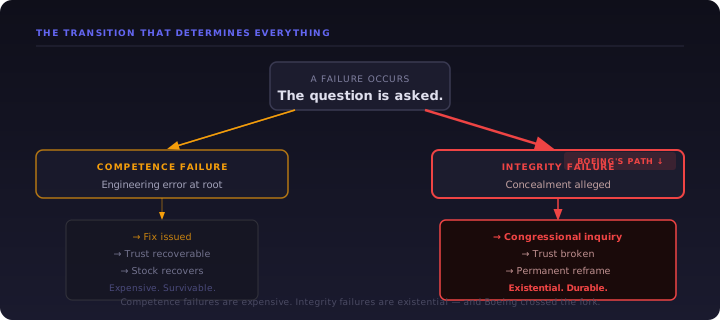
During this entire period, Boeing's stock was relatively stable. Volume was low. Sentiment was mixed-to-neutral. A dashboard would have shown nothing alarming. But the story had already turned.
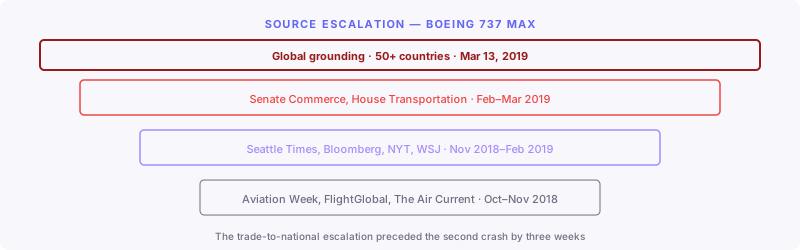
Late February 2019: The story climbs. In the final weeks before the second crash, Boeing coverage appeared in outlets that typically don't cover aviation engineering: the Wall Street Journal's front page, the Washington Post, network news. Congressional staffers were being briefed. The story had climbed from trade press to national press to political engagement — and each step meant a larger audience, higher stakes, and less room for Boeing to shape what happened next.
Ethiopian Airlines Flight 302 — March 2019
On March 10, 2019, Ethiopian Airlines Flight 302 crashed six minutes after takeoff from Addis Ababa. All 157 people on board were killed. It was a Boeing 737 MAX 8.
The second crash broke the "isolated incident" frame permanently. The parallels were immediate and unmistakable: same aircraft type, same flight phase, similar flight-data patterns suggesting MCAS activation. The framing that Boeing's communications team had maintained since October — that Lion Air was an operational anomaly — collapsed within hours.
The global response was swift. China grounded the 737 MAX on March 11. The European Union followed on March 12. Country after country issued grounding orders. The FAA, under mounting pressure and isolated as the last major regulator still permitting MAX flights, issued its emergency grounding order on March 13.
Boeing's stock fell roughly 12% in the week following the crash. By the end of March, the company had lost approximately $65 billion in market capitalization from its October 2018 peak.
But the financial damage, severe as it was, was secondary to the narrative damage. The second crash did not just create a new story. It retroactively reframed the first one. Research by Jong and Broekman documented this effect precisely: the Ethiopian Airlines crash caused a complete reinterpretation of responsibility for the Lion Air crash. What had been a tragic accident with contributing factors became the first data point in a pattern. And the five months between crashes — the months in which Boeing had maintained its frame and resisted design-level explanations — became part of the story too.
How the 737 MAX crisis became a systemic failure story
After the grounding, the narrative moved into its final phase: systemic failure. This was no longer a story about a specific airplane system. It was a story about institutional dysfunction — at Boeing, at the FAA, and in the broader relationship between industry and its regulators.
April — June 2019: Congressional hearings and regulatory scrutiny. The Senate Commerce Committee and House Transportation Committee launched investigations. Testimony from FAA officials, Boeing engineers, and crash victims' families transformed the story from a technical investigation into a political one. The framing in mainstream media shifted from "what went wrong with MCAS" to "how did the system that was supposed to prevent this fail?"
Internal Boeing communications continued to surface, including messages in which employees expressed concerns about the aircraft's certification and, in some cases, mocked the oversight process. These communications were devastating not because they revealed new technical information but because they confirmed the integrity narrative that had been building since January.
July 2019 — January 2020: Financial consequences compound. Boeing took a $4.9 billion charge in Q2 2019 to cover anticipated costs to airlines from the grounding. Production of the 737 MAX was first reduced, then halted entirely in January 2020. The supply chain — hundreds of companies that fed parts into the MAX production line — was disrupted across the country.
The company's full-year 2019 results showed its first annual loss in more than two decades. Orders for the MAX had effectively frozen, while Airbus accumulated a growing backlog advantage.
December 2019: CEO departure. Dennis Muilenburg was removed as CEO on December 23, 2019. His departure was widely interpreted as long overdue — a conclusion the narrative had been building toward for months before the board reached it. The board named David Calhoun as his replacement. The leadership change was framed not as a fresh start but as an acknowledgment that the crisis had been badly managed from the beginning. By the time a board removes a sitting CEO, the coverage has usually crossed governance thresholds the board's own monitoring should have flagged months earlier.
“If anybody ran over the rainbow for the pot of gold on stock, it would have been him.”
January 2021: DOJ settlement. Boeing agreed to pay $2.5 billion to resolve a federal criminal charge related to a conspiracy to defraud the FAA. The settlement included a $243.6 million fine, $1.77 billion in compensation to airline customers, and a $500 million fund for crash victims' families. The deferred prosecution agreement confirmed what the narrative had been asserting for nearly two years: Boeing had withheld information from its regulator.
The 737 MAX returned to service in late 2020, after a 20-month grounding — the longest in commercial aviation history. But the reputational damage extended well beyond the MAX program. Boeing's engineering culture, its relationship with regulators, and its corporate priorities had all been reframed in public consciousness. That reframing proved durable: when a 737 MAX 9 door plug blew out on an Alaska Airlines flight in January 2024, the coverage immediately invoked the MCAS crisis as context. The narrative frame established in 2018-2019 had become the default lens through which Boeing was covered. As researchers at Harvard Law noted, the organizational design choices that led to the MAX failures made them structurally inevitable — which is exactly the frame the media adopted.
Narrative phase timeline
How the Boeing story was framed at each stage — and what monitoring saw vs what was actually happening
What monitoring tools would have shown — and what they missed
A conventional monitoring setup would have caught the obvious signals: volume spikes on crash dates, negative sentiment on both events, growing keyword footprint for "737 MAX." Those are real signals. A team with no monitoring would have been in worse shape.
But the five months between crashes — where the real narrative shifts lived — would have been largely invisible. The shift from "pilot error" to "design flaw" produced no volume spike, just a change in the questions reporters were asking. The shift from "design flaw" to "what did Boeing know?" didn't move sentiment — the coverage was already negative. What changed was the kind of negative: from competence failure to integrity failure. Sentiment analysis treats both framings as equivalently "negative."
The source escalation from trade press to national press to congressional engagement was the clearest leading indicator, and understanding the difference between monitoring and listening matters here: most dashboards show the same metrics for a trade publication story and a Washington Post front-page story. The difference in reach and narrative consequence between those two placements is enormous — and conventional tools flatten it.
What a narrative-aware approach would have caught earlier
The timeline above demonstrates the three signals that volume and sentiment cannot see — frame, source, and arc — and that sentiment analysis alone consistently fails to surface.
Frame changes. "What happened on this flight?" became "What is MCAS?" became "What did Boeing know?" became "How did the system fail?" Each transition was present in a small number of stories from credible sources — detectable, but not the kind of signal that volume or sentiment dashboards are built to flag. The question being asked is often more important than the answer being given, and it changes first.
Source escalation. Aviation Week → Seattle Times → New York Times → Wall Street Journal → congressional hearing rooms. Each step brought a larger audience and higher stakes. The escalation from trade to national press in February 2019 preceded the second crash by three weeks. Nobody could have predicted that crash. But a system tracking source escalation would have flagged that any subsequent incident would be dramatically more damaging than the first.
Arc trajectory. "Isolated incident" is containable — it has a natural resolution. "Pattern of failure" is escalating — each new data point reinforces the frame. "Systemic failure" is transformative — it reframes the subject's identity. Boeing's story moved through all three, and each transition was visible in the coverage before it was obvious in the numbers.
None of this is prediction. It's pattern recognition. The signals were not hidden. They were just not the kind of signals that most tools are built to read.
The Boeing 737 MAX crisis cost the company more than $20 billion in direct financial losses, two CEOs, a 20-month grounding, and a reputational wound that reopened with the first subsequent incident. The human cost — 346 lives — is the fact that matters most and the one that no monitoring system can address.
The four-phase crisis pattern: why this isn't just Boeing
I've focused on Boeing because the public record is deep enough to reconstruct the narrative arc in detail. But the four-phase pattern — isolated incident → design or process flaw → integrity question → systemic indictment — is not unique to aviation. I've watched it repeat across industries:
Pharmaceutical recalls follow the same arc. A reported side effect is framed as rare and expected. Then clinical trial data surfaces suggesting the company knew. Then internal communications emerge. What started as a product issue becomes an integrity story. Johnson & Johnson's talc litigation followed this exact progression over a decade. Theranos followed a structurally similar arc without a precipitating event — there was no crash, no death, no single triggering incident. The narrative moved through all four phases driven entirely by investigative reporting, which makes it an even purer example of how framing shifts compound independent of volume spikes.
Tech company privacy crises follow the same arc. A data breach is framed as an external attack. Then the security posture comes under scrutiny. Then it emerges that the company had been warned. The Equifax breach of 2017 moved from "sophisticated hack" to "they hadn't patched a known vulnerability for months" within weeks — an integrity reframe that cost the CEO his job and the company $700 million.
Financial services scandals follow the same arc. Wells Fargo's fake accounts scandal started as a customer service problem, became a management incentive problem, became a "the board knew" problem. Each transition was visible in how reporters framed the story — months before the formal consequences arrived.
The four-phase pattern
The pattern is consistent enough that I'd call it structural: when a story transitions from competence frame to integrity frame, the window for shaping the narrative is almost always shorter than the team assumes. The Boeing case makes this visible because the timeline is documented in such detail. But the dynamic is operating right now, in some industry, for some company whose communications team is watching a flat green line on their sentiment dashboard.
What monitoring can address is whether a communications team sees the story changing before the consequences arrive. In Boeing's case, the answer was no — not because the signals were absent, but because the tools weren't built to read them. The shifts were there: in the framing, in the sourcing, in the arc. The question was whether anyone was looking.
Related
pillar guide
Media Monitoring vs Social Listening vs Brand Monitoring
Three terms vendors use interchangeably that describe different workflows with different blind spots. Here's what each does and how to pick the right one.
pillar guide
Why Sentiment Analysis Fails During a Reputation Crisis
Sentiment scores tell you how language sounds, not what the story means. During a real crisis, the tone stays calm while the story underneath gets worse.