Guide
Media Monitoring vs Social Listening vs Brand Monitoring
Three terms vendors use interchangeably that describe different workflows with different blind spots. Here's what each does and how to pick the right one.

Key points
- Media monitoring, social listening, and brand monitoring sound interchangeable but serve different workflows. Buying the wrong one means missing the signals that matter most to your team.
Last quarter, I watched a communications director sit through three vendor demos in the same week. One pitched "media monitoring." The next pitched "social listening." The third pitched "brand monitoring." All three showed dashboards. All three mentioned sentiment. All three promised "real-time insights." She left each call more confused than the last — and slightly annoyed that all three seemed to cost a different amount for what appeared to be the same thing.
They're not the same thing. They're not even close. And buying the wrong one is how teams end up with beautiful reports that somehow miss the story unfolding right in front of them. I've seen it happen more times than I'd like to count.
Key insight
Here's the punchline before I walk you through the details: the teams that get burned are the ones who think they bought complete coverage when they actually bought one slice. I've watched a Fortune 500 comms team miss a brewing regulatory story because their social listening tool didn't index the 4,000-circulation trade journal where it broke. I've watched an agency miss a viral employee post because their media monitoring tool doesn't scan LinkedIn. Same budget. Same confidence. Different blind spots.
Let's fix the confusion.
What is media monitoring
Media monitoring is the oldest discipline of the three, and the one with the clearest job description: where did we get mentioned, and what did they say?
It scans news outlets, trade publications, broadcast transcripts, podcasts, and blogs. It finds your brand name, your executives, your competitors, your keywords — and delivers them. A feed. A digest. A clips report. The value is knowing that the Wall Street Journal quoted your CEO on Tuesday, that a healthcare trade journal ran a skeptical piece about your clinical trial, or that a local TV affiliate picked up the press release your team spent three weeks placing.
In practice, this looks like twenty articles on a Monday morning, sorted by outlet reach, with highlights flagged. It's reactive by design — something was published, now you know about it. When Peloton faced its Tread+ recall in 2021, media monitoring was the tool that told their comms team which outlets had the story. What it didn't tell them was how the framing was shifting from "product safety" to "CEO arrogance" in real time — that required a different lens entirely.
What is social listening
Social listening starts from a different premise. Instead of tracking where you were mentioned in editorial content, it tracks what people are saying about you — or about topics adjacent to you — across social platforms, forums, review sites, and community spaces.
The distinction matters more than it sounds. Media monitoring tells you what journalists wrote. Social listening tells you what everyone else is thinking. A social listening tool might surface that a Reddit thread about your product has 400 comments and a deeply negative tone, or that a TikTok trend is associating your brand with something you never intended. It picks up on conversations that will never become a news article but that shape how millions of people actually perceive you.
In practice, social listening looks like a brand strategist noticing that conversation volume around a product launch spiked 300% — but the conversation isn't about the product. It's about a factory labor dispute that surfaced on Twitter the same week. That's the kind of signal social listening catches: unstructured, fast-moving, often emotional, and easy to miss if you're only watching the press.
What is brand monitoring
Brand monitoring is the broadest of the three, and also the fuzziest. It tries to answer: what is the overall health of our brand right now?
Brand monitoring tools typically combine elements of both media monitoring and social listening, then layer on additional signals — review sites, analyst reports, app store ratings, Google search trends, sometimes even stock price correlation. The goal isn't to track individual mentions. It's to produce an aggregate picture: sentiment trending up or down, share of voice relative to competitors, emerging themes in how people talk about you.
In practice, brand monitoring looks like a quarterly report that tells leadership "brand perception improved 12% in Q3, driven by positive sustainability coverage and strong Glassdoor reviews, but we're losing share of voice to Competitor X in the enterprise segment." It's the 30,000-foot view — useful for strategic planning, less useful for deciding what to do this afternoon. When United Airlines had a passenger dragged off a flight in 2017, their brand monitoring dashboard eventually registered the hit. But it registered it as a sentiment dip in a quarterly trend line — not as the kind of acute, hour-by-hour narrative escalation that required a CEO response within twelve hours. The altitude that makes brand monitoring useful for board decks is exactly what makes it useless for the moments that actually define a brand.
Where media monitoring, social listening, and brand monitoring actually diverge
Here's where the vendor demos blur together and where the real differences live.
| Dimension | Media Monitoring | Social Listening | Brand Monitoring |
|---|---|---|---|
| Core question | What did they publish about us? | What are people saying about us? | How is our brand perceived overall? |
| Primary sources | News, trade press, broadcast, podcasts | Social platforms, forums, review sites | All of the above + analyst reports, search trends |
| Speed | Hours (digital) to 24h (broadcast/print) | Near real-time | Days to weeks (aggregate scoring) |
| Best for | Earned media teams, coverage tracking | Brand strategists, consumer insights | Executive reporting, quarterly reviews |
| Blind spot | Pre-narrative social signals | Institutional coverage (trade, regulatory) | Specific actionable moments |
Source coverage is not the same. Media monitoring tools are built for editorial content — they have deep relationships with news databases like LexisNexis, access to broadcast transcript feeds, and strong coverage of trade press. Social listening tools are built for platforms — X, Reddit, TikTok, YouTube comments, niche forums. Sprout Social's comparison frames this as the micro/macro divide, which is useful but incomplete — it only covers two of the three categories. Brand monitoring tools try to aggregate both, but usually have shallower coverage in each. A media monitoring tool will catch a skeptical analyst note in an industry journal. A social listening tool will catch the employee backlash on Blind. Neither guarantees it catches both.
Speed and cadence are different. Think of three weather sources. Social listening is the radar on your phone — updated every few minutes. Media monitoring is the morning TV forecast — solid, but hours behind. Brand monitoring is the Farmer's Almanac — great for seasonal trends, useless for deciding whether you need an umbrella right now.
Social listening is typically near-real-time. Something blows up on Reddit, and you see it within the hour. Media monitoring can be near-real-time for digital outlets, but broadcast and print monitoring often runs on a delay — sometimes 24 hours or more. Brand monitoring is usually the slowest because it's aggregating and scoring across all inputs, which means the "health score" you see today reflects data from the last few days or weeks.
The analytical lens is different. Media monitoring asks: what was the coverage? Social listening asks: what's the conversation? Brand monitoring asks: what's the trend? These are genuinely different questions. A crisis might generate zero media coverage for the first 48 hours while social conversation explodes. If you're only watching media monitoring, you're blind until reporters file their stories. If you're only watching social listening, you might overreact to a vocal minority that never becomes a real story.
What they miss is different. Media monitoring misses the pre-narrative stage — the period when public sentiment is shifting but no journalist has written about it yet. Social listening misses the institutional layer — the analyst downgrade, the regulatory filing, the trade press investigation that sophisticated stakeholders read. Brand monitoring, by smoothing everything into aggregate scores, misses the specific, concrete moments where you need to act. Knowing your sentiment dropped 8% last month doesn't tell you that the drop happened because of one devastating investigative piece that your team should have responded to within hours.
The blind spot
This is exactly why sentiment analysis alone breaks down during reputation crises — aggregate numbers flatten the specifics that actually drive decisions.
Which one your team actually needs
The honest answer: it depends on what your team actually does with the information.
If your primary job is earned media management — tracking coverage, building media lists, reporting on campaign performance, briefing executives on what ran — you need media monitoring. That's your core workflow. Social listening is a nice add-on, but it's not what your daily work requires.
If your primary job is brand strategy or consumer insights — understanding audience perception, tracking cultural trends, informing creative briefs — you need social listening. Media coverage matters, but it's not the primary signal you're working from. Sprout Social's brand monitoring guide breaks down exactly which signals — brand variations, competitive comparisons, leadership mentions — this workflow prioritizes.
If your primary job is reputation risk management — protecting the organization from narrative threats, advising leadership on emerging issues, coordinating crisis response — you need something that none of these three tools fully delivers on their own. You need the editorial coverage from media monitoring, the speed and conversation tracking from social listening, and something neither typically provides: the ability to understand how narratives are forming, shifting, and compounding across all these sources simultaneously.
Most comms teams sit somewhere in that third category, whether they describe it that way or not. They're responsible for knowing when something is becoming a problem, not just when it already is one.

What happens when you buy the wrong one
I know a midsize agency that bought a well-known social listening platform two years ago. It was a serious investment — six figures annually. The tool was excellent at what it did. Their strategists loved the trend reports. They could see conversation themes, track share of voice on social, and produce beautiful quarterly decks for clients.
Then one of their clients — a regional healthcare company — got hit with a series of critical pieces in a state-level trade publication. The articles alleged billing irregularities and cited former employees. The agency's social listening tool didn't pick it up. Not because the tool was broken, but because a 3,000-circulation trade journal isn't a social platform. It's not Reddit. It's not X. It's a publication that regulators, board members, and local journalists read.
By the time the story crossed over into social conversation — three weeks later — it had already been picked up by two local TV stations and a regional daily. The client's CEO called the agency and asked why they were the last to know. The agency had to explain that their monitoring tool simply didn't watch that source. The tool was doing exactly what it was designed to do. It just wasn't designed to do what the agency actually needed. That's an uncomfortable call to make at any price point, let alone six figures.
The reverse happens too. A corporate comms team buys media monitoring, builds a great clips process, and gets blindsided when an employee's LinkedIn post about toxic workplace culture goes viral. It never becomes a "news article" in the traditional sense. It lives on social. The media monitoring tool never sees it. But their board does — because someone always texts the link.
The pattern is the same either way: the tool works perfectly, but it watches the wrong places. And in reputation management, the crisis almost always starts in the place you're not looking.
What reputation risk management actually requires from a monitoring stack
I come back to this question constantly because I've watched the same failure pattern play out across industries. In 2018, Boeing's communications team almost certainly had monitoring in place. They were a $240 billion company with a sophisticated corporate affairs operation. They had coverage tracking. They probably had social listening. They may have had brand health dashboards.
None of it surfaced the narrative shift that was forming underneath the volume. For five months between two crashes, the framing of Boeing's story changed — from pilot error to design flaw to "what did they know?" — while the conventional metrics showed normal-range coverage. The full timeline shows how each transition was visible in the coverage weeks before it appeared in the numbers.
That's not a Boeing problem. It's a category problem. The tools were built to answer "what happened?" They were not built to answer "is the story changing in a way that should worry us?"
The teams that navigate these moments well — and they do exist — tend to share a few practices that don't map neatly to any single tool category:
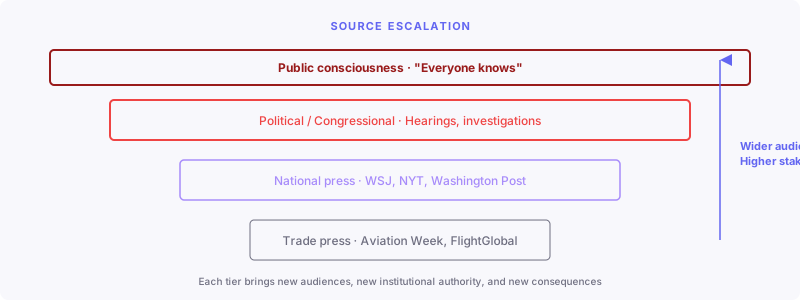
They watch source migration, not just source coverage. When a story moves from Aviation Week to the Washington Post, something has changed that no amount of clip counting reveals. The teams I've seen catch these shifts early are tracking where stories appear over time, not just whether they appear.
They track framing, not just sentiment. The difference between "Company X launches a new product" and "Company X's new product raises safety questions" is invisible to sentiment analysis — both might score as neutral — but the trajectory those two headlines predict is radically different. The teams that catch this are reading for structure, not just tone.
They connect signals across source types. The trade press investigation, the Reddit thread, the analyst downgrade, and the employee Glassdoor review might all be telling the same story from different angles. Individually, each one is a data point. Together, they're a narrative forming. The teams that see the pattern are the ones that aren't siloed into "media monitoring here, social listening there."
They distinguish between noise and change. This is the hardest one, and it's where most tools fail completely. A 15-point sentiment drop that matches the baseline pattern of your industry is noise. A 3-point sentiment drop accompanied by a source-tier escalation and a frame shift is a signal. The only way to tell the difference is to understand the entity's normal pattern — its baseline — and flag deviations from that pattern, not absolute numbers.
These aren't exotic capabilities. They're the things a great comms director does intuitively when she reads the clips in the morning. The question is whether the tools she's paying for are helping her do it, or making her do it despite them. In my experience, it's usually the latter.
Key insight
The newer category framing — vendors selling "AI media monitoring" as if it solved the gap — mostly does not. I have written separately about what AI media monitoring actually changes inside a PR workflow, because the buyer question is rarely the one the demo is set up to answer.
Related
pillar guide
Why Sentiment Analysis Fails During a Reputation Crisis
Sentiment scores tell you how language sounds, not what the story means. During a real crisis, the tone stays calm while the story underneath gets worse.
case study
How Boeing's Narrative Shifted Before the Headlines
Boeing's 737 MAX narrative shifted from pilot error to cover-up over five months. Every transition was visible in the framing before it hit the numbers.