Guide
What AI Media Monitoring Actually Changes for PR Teams
AI monitoring vendors price a feature as a category. Here's what AI actually changes in the PR workflow — and the one question to ask before buying.

Key points
- AI doesn't fix media monitoring — it changes a few specific layers of the PR workflow and leaves the rest alone. The buyer's question isn't 'is AI included.' It's 'what work does AI replace, and was that work the bottleneck?'
I sat through four "AI media monitoring" demos last quarter. By the third one, I started keeping count of how many times the deck used the word "intelligent" without explaining what was intelligent about it. The final tally, across all four, was forty-one. The number of demos that could answer "what specific human task does this replace?" without dissolving into adjectives: zero.
This is the state of the category in 2026. AI is not a product. It is a feature applied unevenly across a workflow that PR teams have been doing for thirty years, and most of the marketing pretends otherwise. The good news: the parts where AI actually helps are real, useful, and worth paying for. The bad news: those parts are smaller and more specific than the pricing suggests.
Here is the punchline, because you will want it before three vendor demos blur into one. AI doesn't fix the wrong layer. Most PR teams are buying AI features that automate work they shouldn't have been doing in the first place — and leaving the layers where judgment actually lives untouched. The right question on a vendor call isn't "is AI included." It's "what specific work does AI replace, and was that work the bottleneck?"
Key insight
Compared to what? I'll get to that — the answer matters more than the technology.
What does AI media monitoring actually do
Strip away the marketing and AI media monitoring is doing four things that pre-AI tools couldn't do well, or couldn't do at all:
It summarizes coverage at scale. Instead of skimming forty articles to file a Monday morning report, an LLM produces a coherent paragraph of what the coverage says, cited back to the originals. This is the highest-value, lowest-controversy use of AI in the PR stack. It turns three hours of scanning into ten minutes of reviewing.
It clusters mentions into narratives. Twenty articles about a product launch and four articles about a labor dispute used to live in the same dashboard as a single coverage spike. AI can sort them into "what story is this" buckets. Gartner has been pushing this category under the term "narrative intelligence", predicting that 45% of CCOs will use narrative intelligence technologies by 2029 to monitor reputation amid rising disinformation.
It interprets sentiment with more nuance than keyword tools. A sarcastic positive ("oh, brilliant work from the customer service team — only two hours on hold") used to flip a dashboard green. Modern LLMs catch most of these. Most. Not all. The Institute for Public Relations is explicit that no method of sentiment analysis will ever be 100% accurate, and PR pros quietly admit they only report sentiment when there's budget for a human to check it.
It drafts response language. "Suggested holding statement" or "draft response to journalist X" buttons are now everywhere. This is useful in roughly the same way a junior staffer's first draft is useful — a starting point that needs an experienced editor before it leaves the building.
That's the real list. Notice what's not on it: AI is not picking up signals your old tool missed. AI is not deciding what's a crisis. AI is not — despite what every demo will tell you — replacing the judgment call about whether to escalate to your CEO. It is making the work upstream of judgment cheaper.
How AI media monitoring works inside the PR workflow
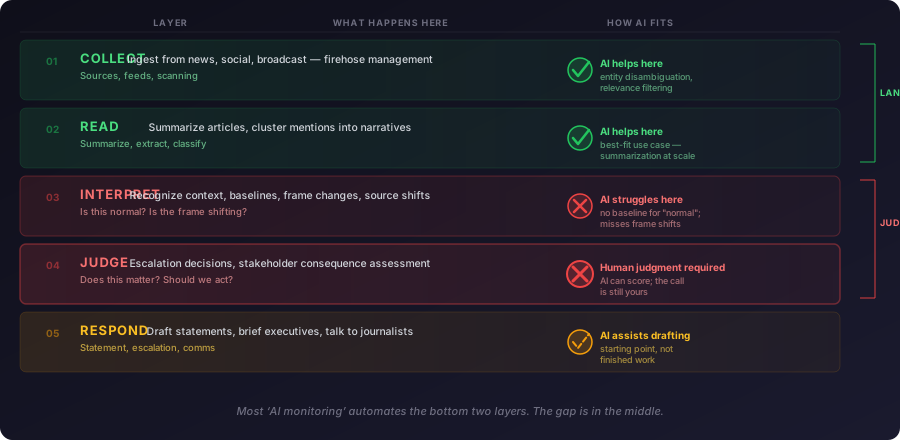
The PR monitoring workflow has roughly five layers. AI shows up at three of them, and the marketing pretends it shows up at all five. Here's a more honest map.
Where AI lives in the PR workflow
AI is not a layer of the stack. It's an accelerant on the layers that involve language. The judgment layer is still you.
Think of a legal assistant and a trial lawyer. The assistant can read a thousand depositions, summarize them, and flag relevant passages — that is what AI does. But the lawyer decides which passage wins the case and whether to settle. AI is the assistant. The judgment is still the lawyer's.
The pattern is consistent across every credible vendor I've evaluated, even if no vendor will say it this directly. AI is excellent at the layers that look like language work — reading, summarizing, classifying, drafting. It is decorative at the layers that involve consequence — deciding what's worth your CEO's morning, deciding what to do, deciding when a moment is the moment.
The honest map
That distinction matters because the judgment layer is the one that actually defines whether a PR team performs well. The teams I've watched navigate genuine reputation events well do not win because their dashboard summarized the coverage faster. They win because someone in the room recognized, three hours before anyone else, that the framing of the story had shifted from "incident" to "pattern." That kind of recognition is the missing layer most monitoring tools never address, and it lives in the judgment layer that AI currently leaves untouched.
AI media monitoring vs traditional media monitoring
Here's where the comparison gets interesting, because the honest answer is: less different than you'd think, and different in the places that matter least.
| Dimension | Media Monitoring | Social Listening | Brand Monitoring |
|---|---|---|---|
| Core question | What did they publish about us? | What are people saying about us? | How is our brand perceived overall? |
| Primary sources | News, trade press, broadcast, podcasts | Social platforms, forums, review sites | All of the above + analyst reports, search trends |
| Speed | Hours (digital) to 24h (broadcast/print) | Near real-time | Days to weeks (aggregate scoring) |
| Best for | Earned media teams, coverage tracking | Brand strategists, consumer insights | Executive reporting, quarterly reviews |
| Blind spot | Pre-narrative social signals | Institutional coverage (trade, regulatory) | Specific actionable moments |
Before going further, it helps to know what category of tool you're actually evaluating — media monitoring, social listening, and brand monitoring are not interchangeable, and AI doesn't change that distinction; it just makes each one a little smoother.
A traditional media monitoring tool — call it Cision circa 2018, now positioning itself as "AI-powered" across its product line — already gave you a list of mentions, a sentiment score, and a basic dashboard. The 2026 version, with its LLM layer, gives you the same list of mentions, a slightly more accurate sentiment score, a paragraph summary of the coverage, and clustered narrative groupings. That is a real improvement. It is not a category change.
The category change everyone keeps promising — proactive reputation intelligence, "predicting" crises before they happen, AI that "understands the why" — is mostly slideware. The vendors who claim the most aggressive version of this are quietly retreating to "decision support" language when their lawyers read the contracts. The reality, captured by Forrester's research, is that 70% of B2B AI buyers will experience buyer's remorse from low-quality AI outputs by 2027. The PR category is not exempt. If anything, it's a leading indicator.
What's actually different in the AI era — and worth paying for — is throughput. The 2018 tool surfaced a story. You read it, decided what it meant, and acted. The 2026 tool surfaces the same story, summarizes it, drafts a holding statement, suggests adjacent narratives to watch, and produces a paragraph for your morning brief. You still read it. You still decide what it means. But the friction between "alert fired" and "I have an opinion" dropped from forty minutes to four. That's not nothing. That's also not a new category — that's a faster version of the old one.
The teams that get burned in the AI transition are the teams who confuse "faster" with "smarter." A faster system that's wrong is more dangerous, not less. I've written before about why sentiment scores in particular create this trap — they make the wrong reading more confidently, and they hide the framing changes that actually predict where a story is going.
“Wherever there is judgment, there is noise — and more of it than you think.”
Best practices for PR teams using AI media monitoring
If you've decided to invest in an AI-augmented monitoring stack — and most teams should, for the throughput reasons above — here are three habits worth bringing into every evaluation. They sound ordinary. The teams that skip them lose money quietly for a year and then quietly cancel.
Ask what the AI replaces, not what it adds. Every vendor will tell you what AI adds: insights, intelligence, automation, the usual lexicon. The better question is what specific human task disappears. "Junior analyst spending forty minutes summarizing yesterday's clips" — yes, that disappears, and that's a real saving. "Senior advisor deciding whether the Wall Street Journal piece is a problem" — no, that does not disappear, and any vendor who suggests it does is selling you the wrong product.
Separate the language work from the judgment work. AI is good at the first, decorative at the second. If you let the same dashboard score "is this a crisis," you are outsourcing the most consequential decision to the layer with the worst track record. When Peloton was navigating its Tread+ recall, an AI summary would have correctly told them what was published. It would not have told them, the way a senior advisor would, that the framing was shifting from "product safety" to "CEO posture" — and that the second one was the actual crisis.
Pilot on a real client, not a demo dataset. The demo dataset is curated. The vendor's AI looks shocking on it. Your actual coverage — niche trade press, regional outlets, internal jargon, your industry's particular flavor of euphemism — is messier, and that's where AI breaks down. A well-known agency I work with quietly cancelled a six-figure contract last year after the pilot showed the vendor's "AI sentiment" was thirty points off from a junior analyst on their actual healthcare client coverage. The dashboard demo had been beautiful. The data the AI was trained on was a different industry.
The buyer's question to bring to every demo
If you take one thing from this piece, take this:
Key insight
When a vendor says "AI-powered media monitoring," ask them, slowly: what specific work does the AI replace, and was that work my bottleneck?
If the answer is "summarization and clustering" — fine, that's a real saving, and worth paying a modest premium for. If the answer is some version of "intelligence" or "insights" with no concrete task underneath, you are buying marketing copy. If the answer is "we replace the judgment of an experienced advisor," you are buying a problem.
The PR teams I've watched make the AI transition well share a few habits. They treat AI as a productivity layer, not a strategy layer. They keep their senior people in the judgment seat. They ask vendors hard, specific questions about which task disappears. They pilot on real data. They walk away from demos that confuse adjective stacking with capability.
The buyer's homework, before the next demo
If a renewal or a procurement is on your calendar in the next quarter, three things are worth doing this week — none of them require the vendor's cooperation.
First, write down the three layers where you actually lose time on a normal Monday. Not the layers you'd like to fix; the ones you actually lose time on. For most teams it's some combination of triage, summarization, and brief-drafting. Match those, on paper, against the five-layer workflow above. The answer is rarely the layer the vendor is selling.
Second, pick four pieces of your actual coverage from the last quarter — two routine, one ambiguous, one where the framing eventually turned. Run them through the vendor's tool in the demo. The demo dataset will sing. Your dataset will tell you the truth.
Third, write the cancellation question at the top of the contract draft: what specifically would have to be true, twelve months from now, for us to not renew? If you cannot articulate the failure mode, you have not articulated the success mode either. The vendor relationships that go badly are the ones where neither side knew.
The throughput improvement from AI is real. The pricing premium is also real. The teams that get the first without overpaying for the second are the ones that did the homework before the demo, not after the contract. And the problems that actually burn PR teams — gaps in source coverage, missed narrative shifts, judgment calls about whether the trade press story matters — are not problems of language. A smarter summarizer will not fix them. Paying attention to the right layer of the workflow will, with or without AI in it.
Compared to what? Compared to the 2018 version, with the marketing turned down and the price tag turned up. Read every vendor pitch from there.
Related
pillar guide
Media Monitoring vs Social Listening vs Brand Monitoring
Three terms vendors use interchangeably that describe different workflows with different blind spots. Here's what each does and how to pick the right one.
pillar guide
Why Sentiment Analysis Fails During a Reputation Crisis
Sentiment scores tell you how language sounds, not what the story means. During a real crisis, the tone stays calm while the story underneath gets worse.
pillar guide
Narrative Tracking: The Missing Layer in Monitoring
Sentiment dashboards watch tone. Media monitoring watches volume. Neither watches the story. Narrative tracking fills the gap that costs teams the most.