Guide
Narrative Tracking: The Missing Layer in Monitoring
Sentiment dashboards watch tone. Media monitoring watches volume. Neither watches the story. Narrative tracking fills the gap that costs teams the most.

Key points
- Most monitoring tools count mentions and score tone. Narrative tracking watches the story being constructed underneath — frame, source escalation, and arc phase. That's the layer that warns you before the volume spikes.
Most reputation monitoring is built to answer the wrong question.
It answers "how loud is this?" when the question that matters is "what kind of story is forming?" Volume and sentiment can both be flat while the narrative around your company quietly reorganizes itself into something you cannot recover from. By the time the dashboard turns red, the story is set and your window to shape it closed days ago.
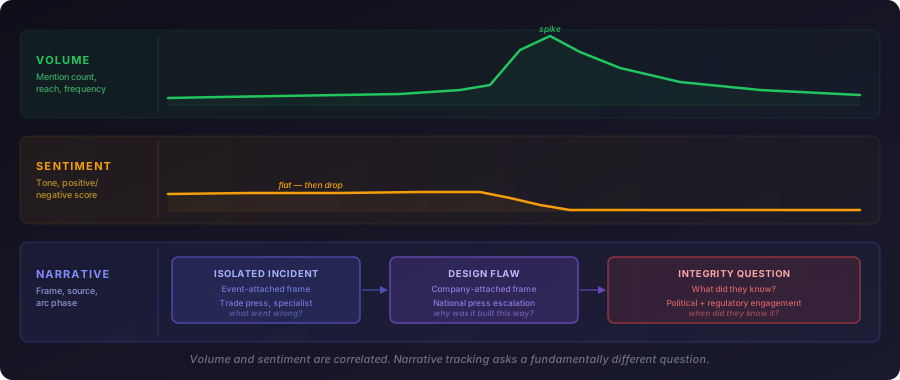
Here is the punchline before I lose anyone: narrative tracking is not one thing. It is three signals — frame, source, and arc — each of which moves before volume does, and none of which a sentiment score can see. If your monitoring stack cannot read those three signals, you are not monitoring narratives. You are monitoring noise.
Key insight
A few years ago I sat in a Tuesday-morning crisis call where the comms director had been showing the executive team a flat sentiment chart for ten days. The chart was correct. Sentiment was flat. Volume was flat. By the end of that call, the company's general counsel was reading the Wall Street Journal and asking why the framing of the underlying story had shifted from "our product" to "our judgment" without anyone flagging it. Nobody had flagged it because the dashboard wasn't built to. The team that saw the turn coming had not been lucky. They had been watching different signals.
What is narrative tracking, and why it isn't sentiment
Narrative tracking is the practice of monitoring the story accumulating around an entity — the implicit argument the coverage is building, the cast of protagonists and antagonists being assembled, and the frame through which any new fact will be read.
It is not sentiment. Sentiment evaluates whether words sound positive or negative. Narrative tracking evaluates what the words are doing — whether they are constructing a competence story or an integrity story, whether the subject of the sentence is the incident or the company, whether the questions being asked are about cause or about culpability.
It is not volume either. A narrative shift can happen across a small number of stories from credible sources, with no spike in mention count. The signal lives in the structure of the coverage, not the size of it — a distinction I unpack further in why volume and narrative significance are not the same.
Most vendor pitches in this space default to "narrative clustering" and "momentum scoring." Those are aggregate metrics, and aggregate metrics tell you about the cluster after it has already formed. The signals I care about — the ones that buy a comms team time — are upstream of the cluster. I want to name them.
The three signals narrative tracking actually monitors
Most articles on this topic talk about narrative tracking as a single capability. That has not matched my experience. In practice it decomposes into three distinct signals, each of which moves on its own clock and each of which requires different inputs to detect.
1. Frame change — the question being asked
“To frame is to select some aspects of a perceived reality and make them more salient in a communicating text, in such a way as to promote a particular problem definition, causal interpretation, moral evaluation, and treatment recommendation.”
A frame is the implicit question a piece of coverage is answering. "What went wrong on this flight?" is a different frame from "Why was this system designed this way?" — even if both sound technical and both are written in neutral language. The first frame keeps the story attached to the event. The second frame attaches the story to the company that built the system.
Frames change quietly. They do not produce volume spikes. They almost never produce sentiment swings, because the language stays measured and factual. What changes is the grammatical structure: the subject of the sentence, the questions in the lede, the sources being quoted. A team watching only sentiment will miss every frame change in a coverage cycle until one of them detonates into the kind of headline a dashboard can finally see — by which point the framing has been hardening in print for weeks.
The single most useful diagnostic I have for frame change is the protagonist-shift test: read the last ten substantive stories about your entity, ignore tone entirely, and ask who the grammatical subject of each sentence is. If the subject has migrated from the event ("the recall," "the outage," "the crash") to your company ("the company," "Boeing," "the firm"), the frame has already turned. The narrative is no longer about a thing that happened. It is about you.
It is like tracking who a courtroom drama focuses on. Early episodes are about "the crime." By mid-season, every scene opens with the defendant's name. When the camera turns from the event to the person, the show has changed — even if the narrator's voice stays exactly the same.
The crash killed 189 people on Lion Air Flight 610.
The flight went down minutes after takeoff from Jakarta.
The recall was contained to a small batch of units.
Boeing built a flight-control system that depended on a single sensor.
The company did not document MCAS in the pilot training materials.
The firm certified the design through delegated FAA authority.
2. Source escalation — where the story is being told
The second signal is the path the story is taking through the media ecosystem. Coverage migrates. It starts somewhere — usually a trade publication or a specialist beat reporter — and climbs. Each step up the ladder brings a larger audience, higher stakes, and less room for the subject of the story to shape what happens next.
The escalation pattern is consistent enough that I treat it as structural: trade press → regional press → national press → opinion columns → political engagement → regulatory or congressional process. Each transition is a leading indicator. By the time a story is in the Wall Street Journal lede, it has been sitting in trade press for weeks and the consequence radius has already widened. Source migration is also one of the four forces that determine when a weak signal crosses the line into material risk — the point at which it starts changing what stakeholders are likely to do next.
Most monitoring dashboards flatten this. A clip from Aviation Week and a clip from the Washington Post show up as the same line item with comparable sentiment scores. The difference in reach, influence, and political consequence between those two placements is enormous, and the difference in what your comms team should do about each one is enormous. Flattening it into a single sentiment trend is how teams end up surprised by a hearing schedule. (This is also one of the cleaner reasons to understand the difference between media monitoring, social listening, and brand monitoring — only one of them is built to track source ladders at all.) Research on narrative framing in political discourse makes the same observation in an academic register: where a story appears determines who reads it as legitimate, which determines who acts on it.
3. Arc phase — what kind of story this is
The third signal is the lifecycle stage of the narrative itself. Reputation stories move through phases that have characteristic dynamics. Different phases call for entirely different responses, and getting the phase wrong is how teams over-respond to noise and under-respond to genuine fracture.
I work with a four-phase model that I have seen repeat across industries: isolated incident (a thing happened, the explanation is contained), design or process flaw (a pattern is being identified, but the framing is still about competence), integrity question (the framing has shifted from "what went wrong" to "what did they know"), and systemic failure (the company's identity itself is being reframed, and individual incidents become evidence for the systemic story). The transitions between phases are the moments that matter. Competence failures are expensive. Integrity failures are existential. Knowing which kind of story you are inside is a precondition for any sane response.
Volume and sentiment cannot tell you which phase you are in. They cannot even tell you that a phase transition has happened, because the transitions are usually quiet — a small number of investigative pieces that reframe everything that follows.
What this looks like in a real case: the Boeing 737 MAX
The cleanest case I can point to is one I have written about at length. The Boeing 737 MAX crisis is the canonical example of all three signals moving while every conventional dashboard read green.
After Lion Air Flight 610 in October 2018, Boeing's coverage looked like a normal post-incident curve: volume spike on the crash date, decay along a typical breaking-news pattern, sentiment negative but attached to the event, source distribution narrow and centered on aviation trade press. A standard monitoring setup would have shown the team that the crash had happened — which they already knew — and not much else.
The frame began shifting in November. The Seattle Times and Bloomberg started writing about MCAS — a flight-control system that depended on a single sensor and that pilots had not been told about. The protagonist of the coverage shifted from Lion Air to Boeing within a few weeks. The implicit question being asked shifted from "what went wrong on this flight?" to "why was this system designed this way?" Volume did not spike. Sentiment did not crater. But the story had quietly stopped being about the airline.
By January and February of 2019, internal Boeing communications were surfacing in the Seattle Times and the New York Times. The frame transitioned again — from design question to integrity question. From "Boeing built a flawed system" to "what did Boeing know?" That transition is the one that matters most. As Reuters has documented across multiple corporate crises, the integrity reframe is the one that produces criminal charges, deferred prosecution agreements, and CEO departures. Competence failures get fixed. Integrity failures get litigated.
By late February, Boeing coverage was on the Wall Street Journal front page and congressional staffers were being briefed. Source escalation was complete. Three weeks later, Ethiopian Airlines Flight 302 crashed, the global grounding followed within days, and the integrity narrative that had been hardening in print for four months became the lens through which everything Boeing did for the next half-decade would be read.
None of those transitions would have triggered a conventional monitoring alert. All three signals — frame, source, arc — were moving. None of them showed up as volume.
Narrative vs sentiment analysis: a different question, not a better dashboard
This is the framing I want communications leaders to internalize, because it changes what they buy and how they brief.
Sentiment analysis answers a question: how does this coverage sound? It is a useful question for product reviews, customer support tickets, marketing campaigns. It is a routinely insufficient question for reputation work because reputation coverage routinely communicates risk in measured, neutral language and routinely communicates safety in language that sounds critical. Tone is not the load-bearing variable.
Narrative tracking answers a different question: what story is forming around this entity? That question requires different inputs (frame, source, arc), produces different outputs (phase classification, escalation paths, integrity-vs-competence diagnosis), and supports different decisions (preempt, contain, accept, respond). It is not a better version of sentiment. It is a different layer entirely. The full three-way framing — including where traditional monitoring fits alongside the other two — sits in this comparison guide that maps each lens against the others.
The mistake teams make is treating narrative tracking as a feature upgrade — "we'll add narrative analytics to our existing sentiment dashboard." That doesn't work. The signals do not live in the same data, and the workflows do not run on the same cadence. You cannot derive frame change from a sentiment score. You cannot derive source escalation from a volume trend. You cannot derive arc phase from either of them.
If you only remember one thing from this piece: narrative tracking is the layer that watches what kind of story is being told. Sentiment watches the loudness of it. Conflating the two is how teams lose weeks they cannot get back.
The load-bearing distinction
How to track media narratives without buying yet another dashboard
I am going to assume you are not in a position to bolt a new platform onto your stack tomorrow. Most teams I work with cannot. Here is what you can start doing this week with whatever monitoring you already have.
Run the protagonist-shift test on the last ten stories about your entity. Ignore sentiment. Ignore volume. Look at the grammatical subject of each lede sentence. If the subject was "the recall" three weeks ago and is "the company" today, treat that as a frame change and brief accordingly.
Map the source ladder for any active story. Where did the first substantive piece appear? Where did the most recent one appear? If you can plot a line from a trade publication to a national outlet, you are watching source escalation in real time. The next step on that ladder almost always involves political engagement, and political engagement runs on a cadence your comms team cannot match by reacting to it.
Name the arc phase out loud at every brief. Is this an isolated incident, a process flaw, an integrity question, or a systemic story? Force the team to commit to a label. The disagreement that surfaces is the conversation you actually need to be having. Treating an integrity story as a process flaw is the most expensive misdiagnosis available, and most teams make it because nobody asked the question.
Use the Boeing pattern as a comparison case. Before declaring that your situation is "contained," check whether the coverage looks more like Boeing in October 2018 or like Boeing in February 2019. As the Institute for Public Relations has argued, the precrisis stage is where outcomes are decided — and the precrisis stage looks calm by definition.
None of this requires new tooling. It requires asking different questions of the coverage you already have.
The Monday diagnostic
The teams I have watched navigate reputation events well were not the ones with the best dashboards. They were the ones who learned to ask, every day, what story was forming. Volume could be flat. Sentiment could be neutral. The story was still being written, and they had figured out how to read it before it was finished.
If this was useful, share it with the comms lead who keeps showing you the green sentiment chart.
Related
pillar guide
Media Monitoring vs Social Listening vs Brand Monitoring
Three terms vendors use interchangeably that describe different workflows with different blind spots. Here's what each does and how to pick the right one.
pillar guide
Why Sentiment Analysis Fails During a Reputation Crisis
Sentiment scores tell you how language sounds, not what the story means. During a real crisis, the tone stays calm while the story underneath gets worse.
case study
How Boeing's Narrative Shifted Before the Headlines
Boeing's 737 MAX narrative shifted from pilot error to cover-up over five months. Every transition was visible in the framing before it hit the numbers.