Guide
From Weak Signal to Material Signal in PR
A signal becomes dangerous not when it gets louder but when it changes who is paying attention. Here's a practical framework for tracking that shift.

Key points
- A signal becomes material not when it gets louder, but when it changes what is likely to happen next. The clearest path from weak to material runs through four forces: repetition, source migration, frame hardening, and stakeholder action. Most teams can spot anomalies. Fewer can tell when the anomaly has gained a constituency.
In the weeks before Silicon Valley Bank collapsed, the signal was not faint. It was everywhere. Venture capitalists were discussing the bank's bond portfolio in private Slack channels. Fintech newsletters had written about the unrealized losses. The Financial Times had published a detailed analysis. And still, when the run started on March 9, 2023, the dominant reaction among observers was surprise.
The signal had been visible for days. What nobody agreed on was whether it meant anything yet.
That is the most common failure mode in reputation risk, and it is not a detection problem. It is a classification problem. The signal arrives. Somebody logs it. Nobody can agree on whether it has crossed from curiosity into consequence. And because there is no shared framework for making that judgment, the team waits. They wait for more data, more volume, more consensus. By the time the consensus arrives, the story has already crossed the threshold that would have justified acting earlier.
Key insight
I want to be precise about the distinction, because it changes what you watch for and how you allocate attention. Most of the weak-signal literature treats the problem as one of detection. The signal is out there; you need better antennae. That framing is not wrong, but it is incomplete. The harder problem, the one that actually determines whether a communications team acts in time, is not whether you noticed the signal. It is whether you could tell that the signal had changed the likely future of the story.
That is what materiality means in reputation work: the signal is now material — meaning it changes what someone with power is likely to do. Not volume. Not sentiment. Not even narrative sophistication. A signal is material when the expected behavior of a regulator, an investor, a partner, or an employee base has shifted because of it. Everything before that point is information. After that point, it is a decision.
What a weak signal looks like in practice
Weak signals are not mysterious. They are mundane. That is precisely why they are hard to act on.
A weak signal might be a single complaint on a niche forum that uses specific technical language — the kind of language that suggests the complainant has inside knowledge or domain expertise, not just a bad experience. It might be a question from a trade reporter that arrives without a deadline attached, the kind of call that suggests they are building a file rather than filing a story. It might be a pattern of similar complaints appearing in three different channels within a month, none of them referencing each other, none of them individually alarming.
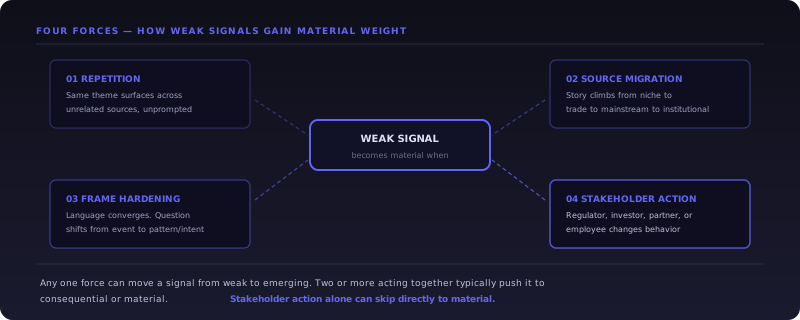
Repetition, migration, framing, and stakeholder action are the four forces. Individually, they create concern. In combination, they create consequence.
The Theranos case is instructive. The earliest skeptical signals appeared in late 2014 — not in mainstream press, but in specialist pathology blogs where experts were asking one question: where is the peer-reviewed validation data? That question was specific, technically informed, and invisible to anyone monitoring volume or sentiment. The full timeline shows the question was in the record over a year before the public consensus caught up.
At Boeing, the pattern was similar. Trade press — specifically Aviation Week and specialist aviation safety outlets — had been asking structural questions about the 737 MAX's MCAS system months before the second crash made the design flaw a mainstream story. The questions were technical, measured, and low-volume. They did not trigger a sentiment alarm. They were, in the language I am building here, weak signals that had not yet gained force.
The point is not that these signals were undetectable. The point is that detecting them is not the hard part. The hard part is knowing when a signal like this has stopped being an isolated data point and started being the early edge of a story that will change stakeholder behavior.
When a signal becomes material
The classification gap
The challenge has not fundamentally changed in decades. What has changed is the speed at which weak signals can gain force and the number of channels through which that force can accumulate.
I draw the materiality line at a specific point: the moment the signal begins to change the expected behavior of the people who can actually do something about it — a regulator, an investor, a board member, a major partner. Before that, the signal is information — it belongs on a watchlist, it deserves tracking, but it does not require decision-making bandwidth. After that, the signal is a decision input. It requires a different kind of attention.
The distinction matters because communications teams have finite bandwidth, and the most common form of monitoring failure is not missing the signal entirely. It is spending so much time on signals that never materialize that the team's escalation authority is eroded by the time a real one arrives. The materiality threshold exists to protect that authority.
Here is how I think about the progression:
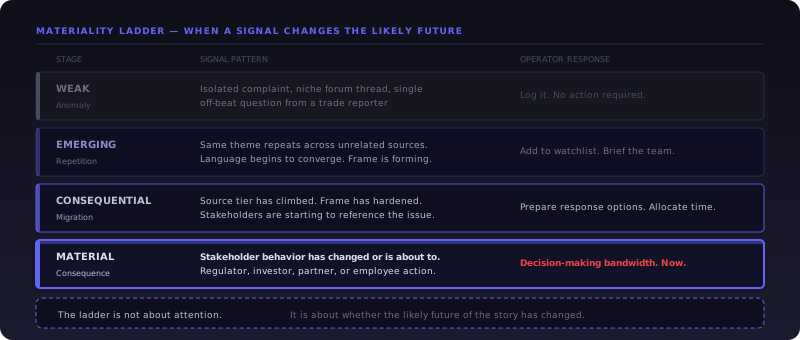
The ladder is not about attention. It is about whether the likely future of the story has changed.
Weak: an anomaly. A single data point without repetition, migration, or stakeholder awareness. Log it.
Emerging: the same theme has appeared in two or more unrelated sources. Language is beginning to converge. A frame is forming, even if it has not hardened. Brief the team.
Consequential: the source tier has climbed. The frame has hardened. Stakeholders are beginning to reference the issue. Prepare response options.
Material: stakeholder behavior has changed or is visibly about to change. A regulator has opened an inquiry. An investor has asked a question on the earnings call. A partner has invoked a contract clause. Decision-making bandwidth, allocated now.
The progression is not always linear. SVB skipped from emerging to material in roughly 48 hours because the people with the power to act — venture capitalists who could withdraw deposits immediately — were concentrated on the same social channels, and they all moved at once. But the structure holds: materiality is not a volume threshold. It is a consequence threshold.
The practical framework: watch, track, escalate
Before going deeper into the mechanics, here is the framework I actually use every Monday morning. It replaces the vague question "should we be worried about this?" with a more structured question: "what stage is this signal at, and what response does that stage warrant?"
At the watch level, you have a single source, no repetition, no frame formation, and a low-authority source tier. The correct response is to log the signal with a date, the source, and the specific language used. Do not brief leadership. Do not allocate comms bandwidth. Re-check in seven days. If the signal has not repeated or migrated, it was probably noise.
At the track level, you have two or more unrelated sources carrying the same theme. Language is beginning to converge. Trade press may have touched it. The correct response is to add the signal to an active watchlist, brief the team, and begin tracking source tier and frame evolution weekly. Draft a holding statement — not because you expect to use it, but because drafting forces you to identify what you would say and reveals whether you have a defensible position.
At the escalate level, the source tier has climbed, the frame has hardened, or a stakeholder has begun to reference the issue. The correct response is a leadership briefing with response options on the table. This is where decision-making bandwidth needs to be allocated — not for the signal itself, but for the trajectory it implies.
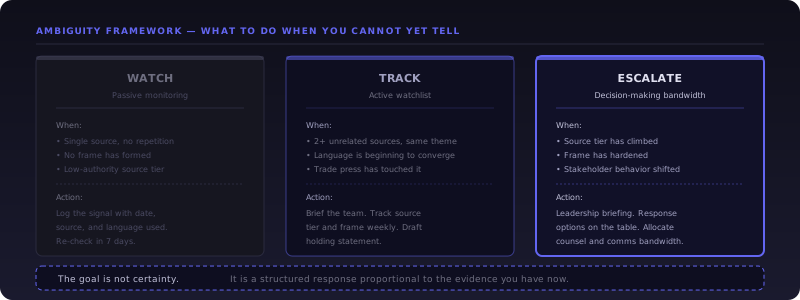
The goal is not certainty. It is a structured response proportional to the evidence you have now.
The framework works because it does not ask "is this a crisis?" That question is binary and premature for most of the signals a team encounters. It asks "what stage is this at?" — which has a structured answer and a proportional response. The rest of this piece explains the forces that move a signal between those levels.
The four ways a weak signal gains force
I have found four forces that consistently move signals from weak toward material. They can operate independently, but they compound. Any one can push a signal from weak to emerging. Two or more acting together typically push it to consequential or material. Stakeholder action alone can skip directly to material.
Repetition. The same theme surfaces across unrelated sources, unprompted. One complaint on a niche forum is noise. The same complaint appearing independently on three different platforms within a month — without the complainants referencing each other — is a pattern. Repetition does not increase the volume much. What it does is establish that the issue exists independently of any single observer's agenda.
The Wells Fargo cross-selling scandal followed this pattern precisely. Regional customer complaints about unauthorized account openings appeared across multiple channels starting in 2013. The Los Angeles Times published a detailed investigation by E. Scott Reckard in December 2013. The complaints were repetitive, sourced, and specific. They were also low-volume by national standards. The repetition pattern was visible years before the Senate Banking Committee hearings in 2016 that turned the story into a defining corporate scandal.
Source migration (the story climbing from niche outlets to bigger, more serious ones). The story climbs from one tier of the media ecosystem to the next. A forum thread picked up by a trade newsletter. A trade newsletter referenced by a national business reporter. A national story referenced in a congressional hearing. Each migration step widens the audience and narrows the entity's room to shape what happens next. I break this out more fully in the next section because it is, in my assessment, the most under-tracked of the four forces.
Frame hardening (the story locking into a shape that becomes harder to change). The language used to describe the issue converges and sharpens. Early coverage might use scattered, exploratory vocabulary. As the frame hardens, a smaller set of words and questions begins to dominate. When Volkswagen's diesel issue was in its early phase, the language was technical and varied: "emissions test irregularity," "discrepancy in NOx readings," "auxiliary emission control device." Once the frame hardened, the language collapsed to two words: "defeat device." That convergence — which is a form of frame change, when the question the coverage is answering shifts from "what happened" to "what does this mean about the organization" — is visible in the coverage record before the consequences land. The EPA's Notice of Violation came on September 18, 2015. The language had been hardening for weeks before that.
Stakeholder action. A consequential actor changes behavior because of the signal. This is the force that most directly creates materiality, and it is the one that can skip the entire progression from weak to material in a single step. When the FDIC seized SVB on March 10, 2023 — two days after the initial stock decline — the stakeholder action (depositor withdrawal at scale, triggered by VC social media) was the signal and the consequence simultaneously. No amount of monitoring sophistication would have given a team more than 48 hours of lead time on that particular cascade. But the structural vulnerability — the bond-portfolio duration mismatch that made the bank susceptible to a run — had been discussed in trade press for months.
Key insight
Why source migration matters more than raw reach
Source migration deserves its own section because it is the force I find most consistently under-tracked by communications teams — and the one that most reliably predicts whether a signal will become material.
The reason is structural. Each tier of the media ecosystem operates on a different set of norms about what constitutes a publishable story. A forum thread requires nothing but an anonymous poster. A trade press piece requires a byline and usually a named source. A national paper requires editorial judgment that the story meets a threshold of public interest. A regulatory inquiry requires a formal determination that the facts warrant investigation. Each transition is not just a wider audience — it means someone more serious looked at the story and decided it was worth reporting.
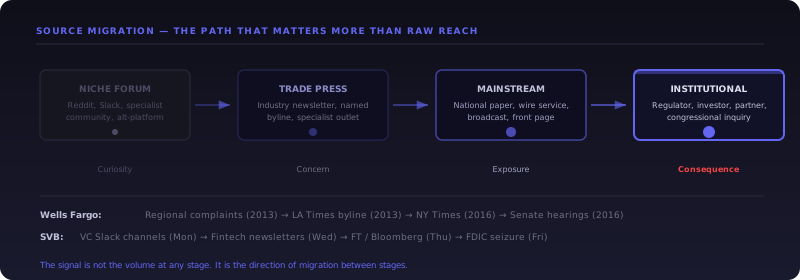
The signal is not the volume at any stage. It is the direction of migration between stages.
That is why I care more about source migration than raw reach. A story with ten thousand social media impressions and zero trade press pickup is a different signal from a story with five hundred trade press readers that just got picked up by the Wall Street Journal. The volume is orders of magnitude larger in the first case. The materiality is higher in the second. The direction of migration — not the magnitude of attention — is the leading indicator.
This is directly related to source escalation as a monitoring concept. The operational insight is the same: track the rung, not the count. A jump from trade press to national paper with no new underlying event means the story has cleared an editorial threshold purely on its own accumulated weight. That is a materiality signal even if the volume has barely moved.
Boeing's 737 MAX coverage illustrates this cleanly. The specialist aviation press was asking structural design questions about MCAS months before the second crash. That coverage was low-volume, technically precise, and read by a narrow audience. When the same questions appeared in the New York Times and the Seattle Times after the Lion Air crash, the source migration — not the volume increase — was the signal that the story had crossed from trade-press concern to public accountability narrative. The Boeing case study traces this arc in detail.
What to do when a signal is still ambiguous
The hardest moments in signal assessment are not when the signal is clearly material. Those are easy — the story has broken, the regulator has moved, the partner has called. The hardest moments are when the signal is somewhere between emerging and consequential and the evidence is genuinely ambiguous.
I have a set of diagnostic questions I run in those moments. They do not resolve the ambiguity — nothing will, until more information arrives. What they do is structure the ambiguity so the team can make a proportional decision rather than oscillating between panic and dismissal.
Is the signal repeating independently? If the same theme is appearing in sources that are unlikely to be coordinating, the signal has moved past anomaly. Independent repetition is one of the most reliable indicators that an issue exists outside any single observer's agenda.
Has the source tier climbed? If the signal started on a forum and is now in trade press, or started in trade press and is now in a national outlet, the migration itself is evidence of materiality. Each tier that picks up the story is an editorial judgment that the story meets a higher bar.
Is the language converging? If different outlets are beginning to use the same vocabulary to describe the issue — particularly vocabulary that carries regulatory, legal, or accountability weight — the frame is hardening. Frame hardening is a leading indicator of consequence because it means the story is becoming easier for more serious actors to carry forward. The dynamics of narrative tracking as a monitoring layer are directly relevant here.
Has any stakeholder changed behavior? If a regulator has asked a question, an investor has flagged the issue, an employee has gone public, or a partner has begun due diligence, the signal has crossed into materiality regardless of what the volume or sentiment numbers say. Stakeholder behavior is the clearest evidence of consequence because it is consequence.
What is the trajectory, independent of current intensity? This is the question most teams skip. The signal may be low-intensity right now. The question is whether the forces acting on it — repetition, migration, framing, stakeholder awareness — are accelerating, stable, or dissipating. A low-intensity signal with an accelerating trajectory is more material than a high-intensity signal that is already fading.
Materiality is not attention alone
The SVB collapse is the starkest example of a signal that moved from ambiguous to material faster than any framework could process. The VC chatter was ambiguous on Monday. By Thursday, the Financial Times had the story. By Friday, the FDIC had the bank. But even in that compressed timeline, the four forces were visible: the theme repeated across VC channels (repetition), climbed to trade and then national press (migration), converged on the language of "duration mismatch" and "unrealized losses" (frame hardening), and triggered immediate depositor behavior (stakeholder action). The framework would not have given a team a week of lead time. It might have given them 24 hours — which, in a bank run, is the difference between orderly and disorderly.
The argument I want to leave with is structural, not prescriptive. Weak signals are not hard to find. They are hard to classify. The teams that handle this well are not the ones with the most sensitive antennae. They are the ones with a shared framework for judging when a signal has moved from curiosity to consequence — and a discipline about matching their response intensity to that judgment rather than to the volume of the conversation.
The four forces — repetition, source migration, frame hardening, stakeholder action — are not a formula. They are a checklist. Run it weekly on the signals your team is tracking. When two or more forces are active on the same signal, the trajectory is toward materiality whether the volume has moved or not. When none are active, the signal is probably noise — and logging it quietly, rather than escalating it loudly, is the response that preserves your credibility for the day a signal genuinely crosses the line.
Most signals stay weak. The ones that do not change what is likely to happen next. That is the test.
Related
editorial
5 Early Signals Before a Story Breaks
Stories don't break out of nowhere. Five precursor patterns are visible 72 hours before the headline — and the dashboard is built to miss all of them.
glossary
Source Escalation in Reputation Monitoring
Source escalation is a story climbing the media ladder — from trade press to mainstream to political engagement. The direction matters more than the volume.
glossary
Frame Change in Reputation Monitoring
A frame change is when the question coverage is answering shifts — from 'what happened' to 'what did they know.' The vocabulary stays calm. The meaning moves.
pillar guide
Narrative Tracking: The Missing Layer in Monitoring
Sentiment dashboards watch tone. Media monitoring watches volume. Neither watches the story. Narrative tracking fills the gap that costs teams the most.