Guide
Why Media Volume and Narrative Significance Are Not the Same
The loudest story is not always the most dangerous. Volume measures exposure. Significance measures meaning. Teams that conflate the two get burned.

Key points
- The most dangerous story in the room is not always the loudest. Volume measures exposure. Significance measures meaning — a change in framing, in source authority, in stakeholder interpretation. Teams that conflate the two end up over-responding to noise and under-responding to the coverage that actually changes their position.
In April 2017, a video of a passenger being dragged off a United Airlines flight went viral in a way that felt, at the time, like a company-ending event. The footage was everywhere. Volume charts spiked into territory most monitoring dashboards had never seen. Social media burned for days. Cable news looped the clip. United's stock price dropped $1.4 billion in market capitalization in a single trading session.
Within three months, the stock had recovered. Within six, the incident had all but disappeared from the coverage landscape. The reputation cost, in terms of lasting structural consequence, was minimal.
Now consider a different kind of coverage. Between 2015 and 2019, a single reporter at the Financial Times — Dan McCrum — published a series of articles questioning the accounting practices at Wirecard, a German payment processing company valued at more than $20 billion. The volume was negligible. The FT's reporting was mostly ignored by the mainstream business press and actively attacked by Wirecard's management. BaFin, Germany's financial regulator, opened an investigation — into the reporter, not the company.
In June 2020, Wirecard collapsed. Its CEO was arrested. Approximately $2 billion in cash that the company claimed to hold did not exist. The FT's low-volume reporting had been tracking the most consequential corporate fraud in modern German history for half a decade.
Key insight
That divergence is where I want to spend time, because it is the source of a specific kind of failure I see repeated across communications teams, agency briefings, and executive dashboards. The assumption that the loudest story is the most dangerous one is intuitive, measurable, easy to chart — and often wrong.
Why teams keep mistaking volume for risk
The reason volume dominates monitoring is not that it is the best signal. It is that it is the most available signal.
Volume is easy to chart. It goes up or it goes down. It can be graphed in real time, benchmarked against averages, compared across entities. It gives you a number, and numbers feel like answers. When a communications team needs to brief leadership on what is happening, the simplest story to tell is how many people are talking about the organization, and whether that number is larger than usual.
“It is not the amount of coverage that matters but the nature of it — a single story in a credible outlet may shape reality more than a hundred stories in outlets that audiences distrust.”
The problem is what volume leaves out. Volume is an exposure metric. It tells you how much coverage exists, how fast it is accumulating, and where it is distributed. It does not tell you what the coverage means, who is carrying it, or whether anyone in a decision-making position will act differently because of it. Those are significance questions, and significance requires a different kind of reading.
I have watched this play out in a consistent pattern. A social media spike generates an urgent briefing. The team escalates. Resources get deployed. Leadership gets anxious. And three weeks later, the story has evaporated with no structural consequences — while a low-volume trade press piece from the same period, the one nobody flagged, has been cited in a regulatory filing.
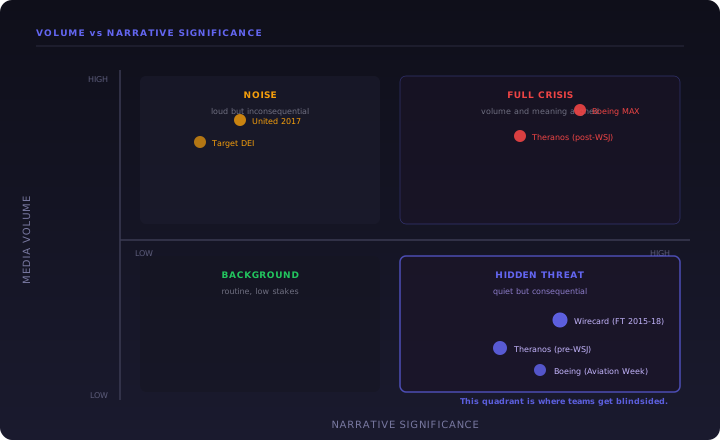
The bottom-right quadrant — low volume, high significance — is where teams get blindsided. Dashboards rarely flag it.
What narrative significance actually means
Significance is not a synonym for severity. It is a structural property of coverage — a measure of what the story now implies for the entity's position, rather than how much attention it is currently receiving.
I think about it through four dimensions. (I explore these in more detail in how signals become material and the five-check escalation lens. Here I will keep the definitions tight.)
Frame severity (how serious is the question the coverage is now asking?). A customer service failure stays in consumer media. A concealment question moves into regulatory and legal territory. The frame determines how far the story can travel — and the shift often happens at low volume, months before mainstream coverage catches up.
Source authority. Who is carrying the story? Source authority determines narrative portability (can this story travel to bigger outlets and more serious audiences?). A thousand social media posts and one Aviation Week article carry completely different consequence profiles — because trade press can be cited by regulators, litigants, and institutional actors.
Narrative portability. Can the story be picked up and carried further? A consumer complaint on social media is hard for a regulator to cite. An investigative piece with named sources and documented evidence is easy to cite. Portability is what determines whether a story stays where it started or climbs to audiences with the power to impose consequences.
Stakeholder implications. Will anyone with structural power — a regulator, investor, board member, or partner — behave differently because of this coverage? If not, the story may be noisy but it is not significant. Wirecard is the cleanest example: the FT's coverage was significant not because it was loud but because the claims, if validated, would require institutional actors to act. They eventually did.
Key insight
Three ways a low-volume story can still be dangerous
The most common failure mode in volume-first monitoring is the false quiet — a story that registers as low priority because the numbers are small, while the structural indicators are moving in a direction that will become consequential.
I see three recurring patterns.
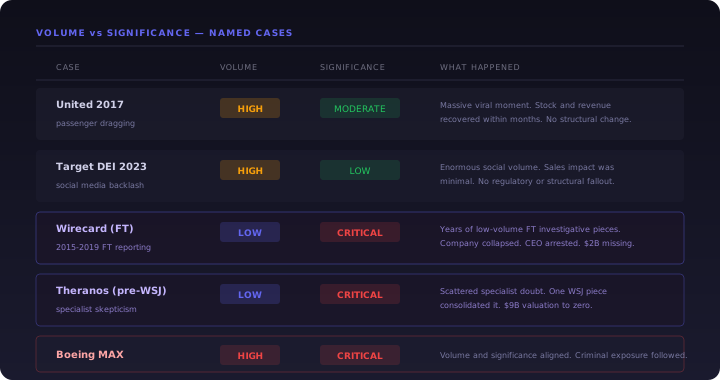
Volume and significance align in the rarest cases. Most of the time, one leads while the other lags — and volume is usually the lagging indicator.
The single-source reframe. One piece of reporting, from one credible source, changes the frame of the entire story. The Theranos case is the cleanest example: John Carreyrou's October 2015 Wall Street Journal article consolidated months of scattered specialist skepticism into a single, structured account with named former employees on the record. The volume before that piece was negligible. The volume after it was enormous. But the significance arrived with the reporting, not with the volume. The WSJ piece did not make the story bigger — it made the story different. The frame shifted from "biotech disruptor" to "questioned methods" in a single news cycle, and that frame shift was irreversible. Monitoring the volume would have shown a spike on October 16, 2015. Monitoring the significance would have shown the frame opening months earlier, in specialist outlets that most dashboards deprioritize.
The trade press signal. Specialist and trade publications often carry stories that are invisible on volume dashboards but highly portable to regulatory and legal actors. When Boeing's 737 MAX MCAS system was being questioned in 2019, the coverage in Aviation Week and the Seattle Times had a fraction of the volume of the social media reaction. It also had structural credibility that social media lacked — expertise, access, and a readership that included regulators, aviation engineers, and congressional staffers. The trade press coverage was what made the story portable to the House Committee on Transportation and eventually to the Department of Justice. I have written about this pattern in the Boeing narrative case study: the dangerous coverage was not the loudest coverage.
The quiet accumulation. Wirecard is the extreme case. Dan McCrum's reporting at the Financial Times ran for years at volumes that would not have tripped any mainstream monitoring alert. The stories were methodical, sourced, and increasingly specific. Each piece added one more documented inconsistency. The company responded with legal threats and lobbying, not corrections. Individually, each article was a low-volume trade press piece. Collectively, they were building the evidentiary record that would eventually force an audit failure, a collapse, and criminal charges. The volume caught up to the significance only when the company's auditor, EY, could not confirm the existence of the missing cash. By then, the significance had been visible for years — but only to readers who were paying attention to the source and the framing, not to the mention count.
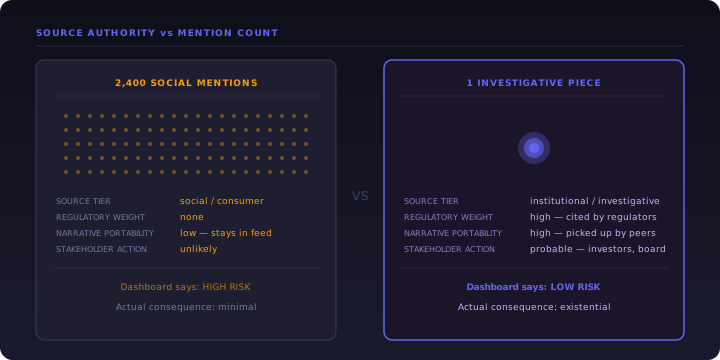
A thousand casual mentions do not outweigh one legitimizing institutional source. Source authority determines who can cite the story — and that determines what happens next.
How to brief exposure and significance separately
The operational mistake I see most often is not that teams ignore significance. It is that they merge it with exposure into a single metric — a composite risk score, a color-coded alert level, a single-line summary — and in the merging, the distinction disappears.
The fix is structural, not algorithmic. Brief exposure and significance as two separate layers. Give leadership both, labeled clearly, so the room can see when they diverge.
An exposure brief answers the question: how much coverage exists, how fast is it moving, and where is it distributed? This is the volume layer. It is useful context. It tells the team whether people are talking, and it helps calibrate the urgency of the response cadence.
A significance brief answers a different question: what does the coverage now imply, who is carrying it, and which stakeholders are likely to change their behavior? This is the meaning layer. It tells the team whether the story has changed category — whether it has moved from noise to signal, from consumer frustration to institutional concern, from an isolated incident to a pattern that regulators or litigants can use.
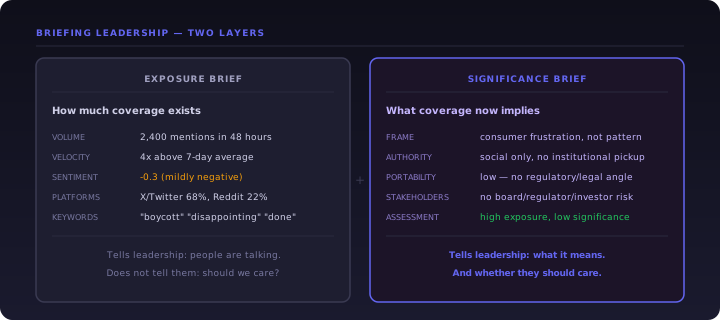
Dashboards make exposure visible. Judgment makes significance legible. Brief both — and label which is which.
The split matters because it forces the briefer to answer the harder question separately from the easier one. I have seen rooms where a massive volume spike led to a war-footing response for a story that had no structural consequence — the 2023 Target DEI backlash is a clear example. Social volume was enormous. The framing was consumer frustration and political signaling. Institutional pickup was minimal. Regulatory interest was nonexistent. Target's actual financial impact was far smaller than the volume would have predicted. A significance layer would have told the room: high exposure, low structural risk. Monitor, but do not mobilize.
Conversely, I have seen rooms where a low-volume trade press piece was buried in a weekly digest while it was quietly building the evidentiary record for a regulatory inquiry. A significance layer would have flagged it: low exposure, high structural risk. Watch this source. Watch this frame.
The two-layer briefing also protects the team's internal credibility. This is a point I have made in the context of why sentiment analysis fails: false alarms — escalating loudly on high-volume, low-consequence stories — erode the team's authority with leadership. When the team correctly distinguishes exposure from significance, the briefs become more useful and the escalations become more trusted.
What to watch instead of raw spikes
If volume is not the lead signal, what is?
I would not discard volume. I would subordinate it. The order I use when reading coverage for significance is:
-
Frame change — when the question the coverage is answering shifts from "what happened" to "what does this mean about the organization." A story about an event is structurally different from a story about a pattern, a concealment, or a failure of judgment. The shift to "what did they know" is the transition that matters most — and frame changes frequently arrive in calm, neutral language at low volume. Track the questions being asked, not the emotional temperature.
-
Source authority. Who wrote it? A single piece in the Financial Times, the Wall Street Journal, Reuters, or a relevant trade publication carries more significance than thousands of social media mentions — because those sources are citable by regulators, referenced by litigants, and read by institutional actors. When a story climbs from social media to trade press to national investigative outlets, the climb itself is a signal. That is source escalation, and it predicts consequence escalation.
-
Narrative portability. Can this story be picked up and carried further? A story with named sources, documented evidence, and a clear accountability frame is portable to congressional hearings, courtrooms, and regulatory filings. A story built on anonymous social complaints and emotional language is not. Portability is the bridge between coverage and consequence.
-
Stakeholder implications. Which decision-makers — regulators, board members, investors, partners — are now more likely to act? If the answer is none, the story is exposure without significance. If the answer is one or more institutional actors, the story has structural weight regardless of its volume.
-
Volume and velocity. Here — and only here — do I want the numbers. And I want them relative to the entity's baseline, not as an absolute. A 300% spike for a consumer brand that routinely generates social media commentary is different from a 300% spike for a B2B company that normally generates ten mentions a week.
Key insight
A better way to explain risk to leadership
The practical implication of everything above is that the way risk is communicated to leadership needs to change.
Most executive-level monitoring summaries lead with volume. The story gets bigger or smaller, the number goes up or down, the dashboard is green or amber or red. This is legible and fast and almost always incomplete. It answers the question leadership is accustomed to asking — "how much coverage are we getting?" — without answering the question that actually drives consequence — "has the story changed category?"
The better briefing leads with meaning and uses volume as context.
Here is the difference, compressed into a single example. Imagine a monitoring dashboard that registers 2,400 mentions across social media in 48 hours. Sentiment is mildly negative. Volume is 4x above baseline. A volume-led briefing says: we have a spike, here are the keywords, we are monitoring. A significance-led briefing says: the volume is social, the framing is consumer frustration without institutional pickup, no source tier above social has carried the story, no stakeholder group has indicated action. Assessment: high exposure, low significance. Recommend standard monitoring cadence, no escalation.
That second briefing takes more judgment to produce. It also gives the room a better foundation for decisions. And it protects the team's credibility for the day the assessment is different — when the volume is low but the source is the Financial Times, the frame is accounting fraud, and the stakeholder implications include the company's auditor and the financial regulator.
The distinction between volume and significance is not a theoretical framework. It is a daily operating decision about what to escalate, what to monitor, and what to brief. Teams that get it right spend less time reacting to noise and more time watching the coverage that actually changes their position. Teams that conflate the two spend their credibility on spikes that fade and miss the stories that do not.
Volume tells you how many people are talking. Significance tells you what the story now means. They are different questions. They deserve different answers. And the one that determines what happens next is almost never the one with the bigger number.
Related
pillar guide
Why Sentiment Analysis Fails During a Reputation Crisis
Sentiment scores tell you how language sounds, not what the story means. During a real crisis, the tone stays calm while the story underneath gets worse.
glossary
Share of Voice in Reputation Monitoring
Share of voice measures what percentage of category coverage you get vs. competitors. High SOV during a crisis is not a win — ask Volkswagen in 2015.
pillar guide
Narrative Tracking: The Missing Layer in Monitoring
Sentiment dashboards watch tone. Media monitoring watches volume. Neither watches the story. Narrative tracking fills the gap that costs teams the most.
case study
Theranos: How Coverage Shifted to Fraud
Theranos looked healthy on every dashboard for two years. The framing in specialist reporting was already shifting 18 months before the WSJ blew it up.
case study
How Boeing's Narrative Shifted Before the Headlines
Boeing's 737 MAX narrative shifted from pilot error to cover-up over five months. Every transition was visible in the framing before it hit the numbers.