Comparison
Narrative Tracking vs Sentiment vs Monitoring
Three monitoring lenses answer three different questions. Teams that only ask one get burned in the seasons the others run quiet. Here's the comparison.

How we evaluate
- The question each category answers
- What it sees clearly
- The signal it cannot detect
- Where it belongs in a healthy stack
Traditional media monitoring
Earned-media reporting, coverage tracking, attribution
+ Authoritative answer to 'where did we get mentioned?'
+ Strong coverage of news, trade press, broadcast, podcasts
+ Auditable clip trail for executive briefings
- Counts presence, not meaning — every clip looks the same
- Reactive: you learn after publication, not before
- Flattens trade press and front-page WSJ to the same line item
Sentiment analysis
Tone benchmarking, campaign sentiment, customer feedback
+ Fast read on whether language sounds positive or negative
+ Useful for product reviews and high-volume social text
+ Cheap to run at scale; aggregates cleanly into dashboards
- Confuses neutral facts with safe coverage
- Cannot detect frame changes — same words, different story
- Averages hide divergence: a polarized debate scores as zero
Narrative tracking
Reputation risk, executive monitoring, pre-crisis reading
+ Reads frame, source escalation, and arc phase, not just tone
+ Surfaces structural shifts before volume or sentiment moves
+ Distinguishes competence stories from integrity stories
- Slower to set up; requires baseline per entity
- Less useful for high-velocity consumer marketing work
- Harder to explain in a single number to a board
I have sat through more vendor demos than is reasonable for one career, and the same scene plays out in roughly four out of five. Three logos on the slide. Three category names. Three pricing tiers. The account executive uses "narrative," "sentiment," and "monitoring" as if they were synonyms in different fonts, and by the time the demo ends the buyer has been quietly nudged toward the conclusion that buying any of the three is the same decision.
It isn't. They are three different categories, answering three different questions, with three different blind spots. Buying one and assuming you have bought the other two is how comms teams end up with beautiful dashboards and surprised executives.
Here is the punchline up front: narrative tracking, sentiment analysis, and traditional monitoring are not competing tools. They are three layers of the same problem, and a healthy reputation stack runs all three on the same coverage at once. The mistake is not picking the wrong one. It is treating any one of them as sufficient.
Key insight
What traditional media monitoring does well, and where it stops
Traditional monitoring is the oldest, most stable category of the three. Its job description is unambiguous: find every place your name was mentioned, log it, and serve it back as a feed. A clip count. A digest. A daily PDF that lands in your inbox at 7:14 a.m. like clockwork.
It scans newswires, trade publications, broadcast transcripts, podcasts, and the open web. It is good at this, in the way that a well-run library is good at retrieval — reliable, auditable, deeply unsexy. Tools in this category typically lean on news databases like LexisNexis Nexis Newsdesk or comparable broadcast feeds. If the question on your desk is "where did we get mentioned this week?", traditional monitoring is the right answer and any other answer is overengineering.
Where it stops is at the question one click deeper: what did those mentions mean? A story in Aviation Week and a front-page story in the Wall Street Journal appear in the same feed, with comparable metadata, often with similar sentiment scores if the dashboard has bolted one on. The difference in reach, political consequence, and downstream cost between those two placements is enormous. Traditional monitoring does not see it. It was not built to.
It is also reactive by definition. Something was published. Now you know about it. The interesting question — why it was published, where it sits in a story arc, which signals predicted it three weeks ago — lives upstream of where the clip-counter looks. As I have noted in my writeup of the difference between media monitoring, social listening, and brand monitoring, this category serves earned-media teams beautifully and crisis teams poorly.
What sentiment analysis does well, and where it breaks
Sentiment analysis answers a different question: how does this coverage sound? It scores text — positive, negative, neutral — and aggregates the scores into a number you can put on a slide.
Inside its real domain, it works. Customer reviews, support tickets, marketing copy, high-volume social posts where the writer's emotional load matches the words on the page — sentiment scoring does an honest job. A 4.7-star review that says "I love this thing" is positive. A 1.2-star "worst purchase of my year" is negative. The model and the meaning agree.
Reputation coverage is a different beast, and this is where most teams get burned. As Hypefactors documented in its analysis of sentiment limitations, the language of serious editorial coverage is routinely measured, technical, and neutral — and the implications are routinely the opposite of neutral. A trade publication writing "the company restructured its safety review division six months before the first complaints surfaced" is constructing a timeline that implies negligence. The sentiment score on that sentence is somewhere around zero. The legal exposure is not.
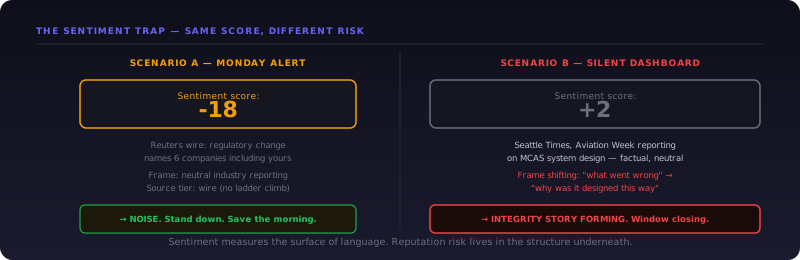
This is the failure mode I see most often: the Monday-morning sentiment dip. The dashboard turns amber, the comms director writes a brief, the executive team gets pulled into a 9:30 stand-up, and two hours later somebody figures out the dip was a Reuters wire about a regulatory change naming six companies including yours. Negative tone, zero meaning. You spent the morning of the week you needed for real work on a problem the dashboard manufactured. I watched one team spend $40,000 in agency fees responding to a sentiment spike that turned out to be a single syndicated op-ed reprinted across 47 regional outlets — every clip identical, every clip counted separately. The coverage touched no editorial decision-maker. The board saw the clip volume and called an emergency session anyway.
The reverse is the more dangerous one. Neutral sentiment during the early weeks of a genuine reputation event. The coverage is factual. The framing is shifting. The dashboard is green. By the time the score finally turns, the story is set and your window to shape it closed three weeks ago. I have written about why sentiment analysis fails during a reputation crisis at length, but the short version is: sentiment measures the surface of the language, and reputation risk lives in the structure underneath.
What narrative tracking adds, and where it doesn't fit
“The narrative fallacy addresses our limited ability to look at sequences of facts without weaving an explanation into them, or, equivalently, forcing a logical link, an arrow of relationship, upon them.”
Taleb was warning about the narratives we fabricate to make sense of randomness. The kind I track are different — they are constructed deliberately by reporters and amplified by institutional actors. They are not illusions. They are structural features of coverage. The distinction matters because it determines whether you treat narrative as noise to filter out or signal to read.
Narrative tracking is the youngest of the three categories, and the one most at risk of being sold as a feature upgrade rather than a different layer. It answers the question that the other two cannot: what kind of story is forming around this entity?
Concretely, that question decomposes into three signals: frame (what implicit question is the coverage answering — competence, design, integrity, or systemic?), source escalation (where in the media ecosystem is the story being told, and is it climbing the ladder from trade press toward national outlets and political engagement?), and arc phase (is this an isolated incident, a process flaw, an integrity question, or a systemic story?). I have laid out the full framework in the missing layer in reputation monitoring; for the purposes of this comparison, the load-bearing point is that all three signals move before volume or sentiment do.
Think of watching a river. Volume is the water level — it rises last. But upstream, you can see the rain falling (frame change), the tributaries feeding in (source escalation), and the bank erosion (arc phase). By the time the water rises at your doorstep, the three upstream signals have been visible for hours.
Where narrative tracking earns its keep is the season where the other two run quiet. The pre-narrative weeks of an emerging issue. The phase transition from "competence story" to "integrity story" — a transition that, as Reuters reporting on the Boeing 737 MAX guilty plea makes obvious in retrospect, is the one that produces criminal charges, deferred prosecution agreements, and CEO departures.
The comms director who lives through this transition describes the same thing every time: a moment, usually in week four or five, when they realize the press is no longer asking what happened — they are asking who decided. That realization, arriving in a Monday debrief, is the moment the legal team gets a permanent seat at the table.
Competence failures are expensive. Integrity failures are existential. Telling them apart in advance is the entire job. Sentiment and clip counts cannot.
Where narrative tracking does not earn its keep is the place buyers most often expect it to. High-velocity consumer marketing work. Campaign sentiment for a launch week. Brand-perception swings driven by an influencer. The signals narrative tracking reads are slow, structural, and require a baseline per entity to be meaningful. If your job is to know whether a product launch landed warmer than the last one, sentiment is faster, cheaper, and good enough. If your job is to know whether the Wall Street Journal is about to reframe your CEO's last decision as a values question, narrative tracking is the only lens that will tell you in time.
How the three categories actually compare
The honest comparison sits in the summary cards at the top of this page — what each lens is best for, what it sees, and where it stops. The category-level pattern is worth naming explicitly, because it is the part vendors are least incentivized to make clear:
- Traditional monitoring tells you what was published. It is the best feed in the world for "did the press release land?" and the worst possible answer for "is the story changing?"
- Sentiment analysis tells you what the words sound like. It is right when tone equals meaning and dangerous when they diverge. They diverge in almost every reputation event of consequence.
- Narrative tracking tells you what kind of story is forming. It moves earliest, requires the most context, and is the only lens that distinguishes a process flaw from an integrity question.
The mistake I watch teams make most often is not buying the wrong category. It is mistaking an alert from one lens for an alert from another. A sentiment dip is treated as a narrative shift. A volume spike is treated as a story turn. A frame change is missed because the dashboard those two run on does not have a column for it.
The misidentification problem
Each category's blind spot — and why they cluster
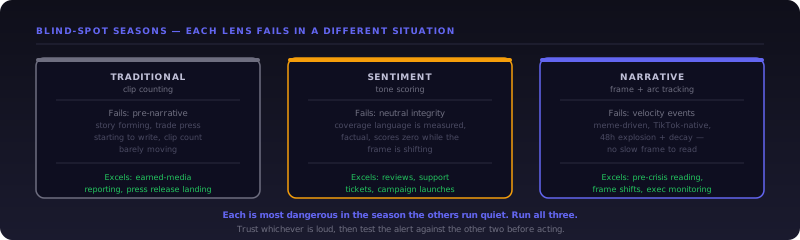
A useful way to read these three categories is to ask, for any given week of coverage, which lens is most likely to be wrong right now. They fail in different seasons.
Traditional monitoring fails in the pre-narrative weeks. The story is forming, the trade press is starting to write, and the clip count is barely moving. The dashboard is calm and the risk is real. The teams that catch this watch source ladders, not clip totals — and most monitoring tools flatten the ladder into a list.
Sentiment analysis fails when neutral language carries integrity weight. The early MCAS reporting in November 2018 was technical, factual, largely neutral in tone. The questions had already shifted from "what went wrong on this flight?" to "why was this system designed this way?" Sentiment models read the words. They did not read the question structure.
Narrative tracking fails on velocity-driven consumer events. A meme-driven backlash that explodes inside 48 hours and decays inside a week does not have a slow-moving frame to track. The signal is the volume and the platform mix, and that is sentiment-and-listening territory. Trying to read arc phase on a TikTok-native event the way you read it on a regulatory story is overfitting an instrument to the wrong job.
The blind-spot rule is simple: each category is most dangerous in the season the others run quiet. A healthy stack does not pick one. It runs all three and trusts whichever one is loud at any given moment, then tests the alert against the other two before acting.
What this looks like during a real event
The worked case I want to apply the three lenses to here is Theranos — which I have reconstructed at length in the Theranos narrative timeline. It is a different shape from the Boeing case covered elsewhere in this library, and the differences are instructive.
Through early 2015, traditional monitoring on Theranos would have shown steady, elevated volume with strongly positive sentiment. Fortune, Forbes, Time, The New Yorker — the clip trail was aspirational, the tone was celebratory, and the dashboard was green. A monitoring feed would have told a comms team exactly what they wanted to hear.
Sentiment analysis would have agreed. The language in mainstream Theranos coverage was positive in the straightforward sense — "visionary," "disruptor," "democratizing blood testing." There was no tone problem to detect because the coverage that mattered was not using negative language. The skeptical pieces appearing in specialist pathology outlets and STAT News were neutral and technical in tone: "Where is the peer-reviewed validation data?" That question scores near zero on a sentiment model. Its implications do not score near zero.
Narrative tracking would have seen three things the other lenses missed. First, a source-composition mismatch: the celebratory frame was being built by outlets without scientific expertise, while the questions were being asked by outlets that had it. Second, a vocabulary shift: words from regulatory science — "validation," "peer review," "proficiency testing" — entering a narrative previously built on Silicon Valley vocabulary. Third, conspicuous absences: no peer-reviewed paper, no academic medical-center endorsement, no independent validation in a category where all three would normally be present. By mid-2015, months before Carreyrou's Wall Street Journal investigation consolidated the skepticism into a single front-page story, the frame was already thinning for anyone reading the structure of the coverage rather than its tone.
That is not a sentiment story or a clip-count story. It is a frame, source, and arc story, and only one of the three lenses on this page would have surfaced it in time.
How to decide which gap is yours
The last question, and the one most teams skip past in the rush to procurement: which of these gaps is yours, today?
If you cannot reliably answer "what was published about us this week, and where did it land?" — your gap is traditional monitoring. Fix that first. The other two are wasted on a team that does not have a clip trail.
If you can answer that question but you cannot tell the difference between a Reuters wire that mentions you and a Wall Street Journal investigation that is about you — your gap is interpretive. You probably already have sentiment analysis bolted on and you are confusing its output with judgment. Sentiment is not the upgrade you need.
If you can answer both, but the last three reputation events your team navigated felt like surprises that should have been visible earlier — your gap is narrative tracking. The signal you need is upstream of the volume your dashboard counts and the tone your scorer reads.
Most comms operations sit in that third category, whether or not the procurement document says so. They have monitoring. They have sentiment. They are responsible for knowing when something is becoming a problem, not just when it already is one — and the lens that answers that question is not the one their dashboards were built around.
A Monday-morning triage you can run this week
You do not need new tooling to start fixing this. You need to start asking the right question of every alert your stack produces.
This Monday, take the last five alerts your stack escalated — the dashboard turning amber, the email digest flagged red, the inbound from the agency. For each, write down which of the three lenses produced the alert: volume (traditional monitoring), tone (sentiment), or structure (narrative)? Then ask, against the other two lenses, whether they agreed. A volume spike with a flat frame and no source escalation is almost always noise. A neutral-tone story with a frame change and a source-tier jump is almost always the one that should have been escalated and wasn't.
If you cannot run that triage with the tools you have, you have just identified your gap. That is more useful than any vendor demo you will sit through this quarter — and as the Institute for Public Relations has long argued in its work on the precrisis stage, the precrisis stage is where outcomes are decided. The lens you use to read it determines what you see.
The teams I have watched navigate reputation events well were not the ones with the deepest monitoring stack. They were the ones who learned, every Monday, to ask which of the three questions their alert actually answered — and which of the other two it had quietly failed to.
Monday triage rule
Related
pillar guide
Narrative Tracking: The Missing Layer in Monitoring
Sentiment dashboards watch tone. Media monitoring watches volume. Neither watches the story. Narrative tracking fills the gap that costs teams the most.
pillar guide
Why Sentiment Analysis Fails During a Reputation Crisis
Sentiment scores tell you how language sounds, not what the story means. During a real crisis, the tone stays calm while the story underneath gets worse.
pillar guide
Media Monitoring vs Social Listening vs Brand Monitoring
Three terms vendors use interchangeably that describe different workflows with different blind spots. Here's what each does and how to pick the right one.