Editorial
Bud Light Backlash: Signals That Showed Up First
The Bud Light backlash was visible for 43 days in channels nobody on the brand side was watching. Here's the signal sequence and what it teaches.
Key points
- The Bud Light backlash wasn't a sudden event. It was a slow leak in cultural channels — Telegram threads, country-music creator videos, alt-platform comment sections — that escalated for weeks before mainstream press named it. By the time the sales chart turned, the story was already over.
I have watched a lot of brands get hit by something they didn't see coming. Bud Light is the one that bothers me, because the signal wasn't faint. The signal was loud. It was just loud somewhere the marketing team wasn't listening.
By April 14, 2023 — the day Anheuser-Busch's CEO finally said something resembling a public statement — the story had been live for nearly two weeks in mainstream press, six weeks in alt-social platforms, and roughly forty-eight hours in the part of TikTok that decides what country bars play that summer. The financial damage — a 25%+ sales drop, $1.4 billion in lost U.S. beer revenue, and a 30% year-over-year decline that persisted into 2024 — was the last thing to show up. Not the first.
Most of the analysis you can find on this episode reads it as a culture-war event, which it was, or as a strategic misread of customer base, which it also was. I want to read it as something more boring and more useful: a monitoring failure. The story was visible. Nobody on the brand side was looking at the right surface.
Key insight
The Bud Light backlash timeline, by channel
Here is the sequence as it actually unfolded, organized by where each signal lived. The vertical axis here isn't time. It's who-was-watching.
Cultural-channel cascade
The Bud Light signal moved through five distinct channel layers before reaching financial consequence — each layer wider than the last, each layer invisible to the layer above.
- 1
Late Feb 2023 — Alt-social ignition
Mulvaney's first Bud Light Instagram post in February draws limited mainstream attention. It is, however, flagged on KiwiFarms and circulated through anti-trans Telegram channels. The story has a name and a target, two months before the press uses either.
- 2
April 1 — Twitter ignites the bridge
Mulvaney's March Madness video lands. @OliLondonTV reposts it the same day; @DC_Draino picks it up April 2. Engagement is in the thousands, not the millions. To a sentiment dashboard: noise. To anyone watching the network: a coordinated handoff from alt-platforms to mainstream Twitter.
- 3
April 3 — The imitation template arrives
Kid Rock posts the submachine-gun video. It clears 11 million views in five weeks. More importantly, it provides a template: a thirty-second clip of someone destroying the product. Within seventy-two hours, that template has been reproduced thousands of times on TikTok by people Anheuser-Busch has never heard of.
- 4
April 4–10 — The country-music creator stack
Travis Tritt and John Rich publicly distance themselves. Riley Green changes the lyric of "I Wish Grandpas Never Died" from "cold Bud Light" to "Coors Light" mid-concert in Nashville. The crowd loses it. The clip moves on TikTok the same night. This is the moment the brand stopped being neutral in country culture.
- 5
April 14+ — Mainstream catch-up
CEO Brendan Whitworth issues a statement intended to defuse the conflict. Sales have already dropped 11% the week ending April 8 and 21% the week ending April 15. The marketing VP takes a leave of absence. The press calls this the start of the crisis. The crisis has been running for forty-three days.
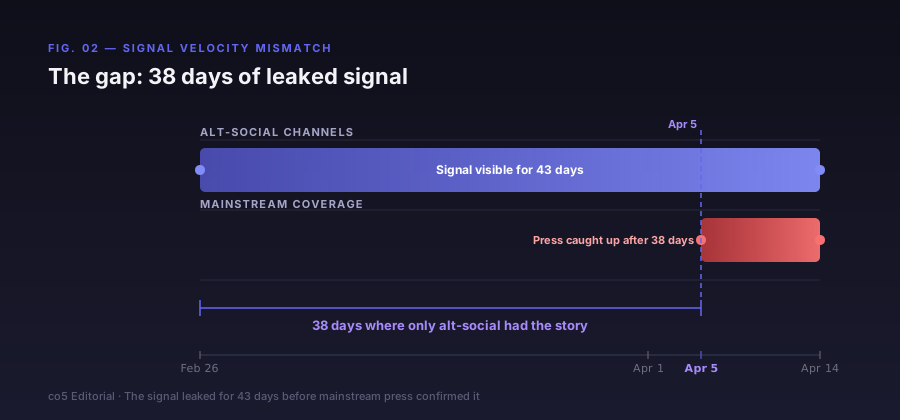
The signal leaked for 43 days before mainstream press confirmed it.
The thing I want you to notice is that nothing in steps 1–4 would have registered as a crisis on a conventional brand monitoring dashboard. Mention volume was flat for most of February and March. Sentiment was fragmented across platforms that traditional monitoring tools either don't index (KiwiFarms, Telegram) or index but don't weight (TikTok comment sections, country-music creator livestreams). The numbers a comms team would have been staring at would have shown a brand executing a campaign on schedule.
What caused the Bud Light boycott — and what didn't
The consensus story is that Bud Light "took a stance" and got punished for it. I think that's mostly wrong, or at least incomplete. The boycott wasn't caused by the partnership itself. It was caused by the partnership colliding with a parasocial brand that wasn't built to absorb it.
A parasocial brand is one whose customers feel an identity attachment to the product that exceeds its functional utility. Bud Light's own VP of marketing famously described the legacy brand as "fratty" and "out of touch" in a March podcast appearance — a phrase that surfaced just as the backlash was forming and read, to the existing customer base, as contempt for them specifically. The HBR analysis of the episode, a year later, found that switching costs in the light-beer category are essentially zero — blind taste tests show drinkers can't reliably distinguish Bud Light from Coors Light or Miller Lite. So the only thing keeping the customer there was the identity attachment. Once that was on the table, there was nothing else to hold them.
This is a structural condition, not a political one. It applies to any brand whose moat is built on tribe rather than function. Country-radio brands. Pickup-truck loyalty. Certain athletic apparel lines. Certain whiskeys. The list is longer than most marketers would like to admit. And the early-warning sign that you're in this kind of brand is not in your sentiment scores — it's in whether your customers talk about your product as a way of describing themselves.
The parasocial trap
"We've lost a whole generation of hardcore Bud Light shoppers. It's going to take us at least 10 years to try and recapture what we lost in one year."
Bump Williams, beer industry analyst, interviewed by Yahoo Finance, July 2024
Cultural signals brand monitoring missed
I want to be precise about what a monitoring tool would have seen vs. what it would have missed, because the gap is the whole point.
What a conventional dashboard would have shown by April 5: A spike in Twitter mentions of "Bud Light" and "Mulvaney." A sentiment score moving negative. A handful of clips from conservative news sites. Volume rising on a familiar curve.
What a conventional dashboard would not have shown: The first KiwiFarms thread from February. The Telegram channel where the partnership was being discussed before the campaign launched. The TikTok creator stack — accounts in the 50K-500K follower range, the layer that drives country-music taste — quietly converting on April 2 and 3. The lyric swap at Nissan Stadium, which existed for forty-eight hours as a clip on a country fan account before it was a news story. The fact that the meme template Kid Rock created (destroy the product, post the video) had been replicated more than ten thousand times by independent users before mainstream press noticed.
The conventional dashboard is built to see scale. Cultural ignition doesn't start at scale. It starts at imitation. The right question on April 4 wasn't "how many people are talking about us?" — the answer was a few thousand, which any monitoring tool would have correctly described as small. The right question was "is the way they're talking about us being copied?" That's a different signal entirely, and it's a signal the dominant tools in the brand-monitoring category were not built to detect.
This is the same gap that made the Boeing 737 MAX crisis legible weeks before mainstream coverage caught up — the framing in aviation trade press shifted from "pilot error" to "design flaw" in November 2018, months before the second crash and the worldwide grounding. Different industry, different mechanism, same underlying pattern. The framing changed in specialist channels first; the volume changed last. Bud Light is the consumer-brand version of the same dynamic, compressed from months into days. The compressed version has its own structure: five precursor patterns repeat in roughly the same order in the seventy-two hours before nearly every brand story breaks, and Bud Light hit four of them in the first week of April.
How cultural backlash actually distributes itself
Here is the part most analyses get backwards. The Kid Rock video was not the cause of the Bud Light backlash. Kid Rock had been complaining about woke marketing for years and almost nobody had moved on it. What changed in April 2023 was that he produced a piece of content with a clean imitation template — a thirty-second video, a single product, a clear gesture, a punchline. Imitation templates are how cultural backlash actually distributes itself, and they are the precondition for financial impact, not its consequence.
Scroll back through TikTok in the first two weeks of April 2023. The first few hundred imitator videos are almost all variations on the same gesture: someone in a backyard or a parking lot with a case of Bud Light, doing some version of destroying it. Different people, same script. By the time the country bars in Texas and Tennessee started posting their own pour-out videos, there was no central organizer. There didn't need to be. The template was self-replicating, and sales declines lag this kind of meme saturation by ten to fourteen days because retail purchase decisions don't move in real time — they move on the next grocery run. So when AB InBev's CEO finally issued his "we never intended to be part of a discussion that divides people" statement on April 14, the meme template had already been distributed for eleven days, the imitation layer was saturated, and the next two weeks of sales decline were structurally locked in. The statement could not have changed the outcome. The cause of the sales decline was already in the past.
“For a company to hire a trans person and then not publicly stand by them is worse in my opinion than not hiring a trans person at all, because it gives customers permission to be as transphobic and hateful as they want.”
“We never intended to be part of a discussion that divides people. We are in the business of bringing people together over a beer.”
Detecting this in time is harder than detecting volume — and that is why conventional brand monitoring opted out of it. A volume spike is a single number going up. An imitation template requires noticing that thousands of pieces of content share a structural similarity even when the words and faces are different. Until recently, that capability was over-engineering for the problem; cultural backlash used to take six weeks to spread, and a press release could meet it. Bud Light is the clean demonstration that the velocity has compressed past the point where conventional monitoring cadences are useful. By the time the Monday morning report lands on a comms director's desk, the relevant cycle has already ended. (Sentiment scoring, separately, flattens contagious imitation and isolated complaint into the same negative number — they are not the same thing, and treating them as one is actively misleading in this kind of episode.)
The implication is uncomfortable for crisis communications teams: by the time you have a financially measurable problem, the window in which a statement could have shaped the outcome has already closed. The statement is theater. The damage is structural. It was decided in the imitation layer days earlier.
The imitation layer decides it
What the signal would have looked like in real time
If I were trying to describe the kind of read that would have flagged Bud Light early — for the comms director who is reading this and trying to figure out what to do differently — it would have looked something like this:
In late February, an unfamiliar pattern of mentions on three alt-social surfaces, low volume but high coordination. In mid-March, the brand's own VP saying something publicly that, decoded, read as contempt for her existing customer base. On April 1, a sponsored post landing inside a parasocial brand without the audience-segmentation infrastructure to absorb it. On April 2, a Twitter handoff from low-reach to mid-reach accounts. On April 3, an imitation template igniting in the country-music creator stack — the first signal that was unambiguously bad and unambiguously fast. By April 4, the cycle was decided.
None of those signals required a special tool. They required a person whose job was to watch them — and an organization that treated cultural channels as primary brand surfaces, not as fringe.
The Bud Light story isn't just about Bud Light
Every six to eighteen months, some brand becomes the next instance of this same pattern. The targets rotate. The mechanic doesn't. A parasocial brand makes a signaling choice that lands inside a customer base whose attachment is identity-based rather than functional. A piece of imitation-friendly content goes up in the channels mainstream monitoring doesn't index. The template replicates. By the time the press names it, the meme has saturated and the sales trajectory is set.
What I keep coming back to is the gap. Six weeks in alt-social. Forty-eight hours in the country-music creator stack. Eleven days of imitation-template saturation. Then — only then — the financial damage. Every layer was visible. The only thing missing was the choice to look.
What to actually start watching, this Monday
If you are running brand monitoring for a parasocial brand and the Bud Light pattern bothers you the way it bothers me, three concrete moves are worth making this week. None of them require new tools.
First, name your parasocial exposure. Write down — for your own brand or your client's — the one or two identity claims your customers attach to the product. Pickup-truck loyalty. Country-radio identity. Particular political affinities. Particular athletic-apparel tribes. If you cannot articulate the identity claim, you are not yet ready to read the channels where it lives.
Second, identify the cultural-channel layer that decides taste in that identity. For a country-music-adjacent brand, that's a specific creator stack on TikTok and Instagram (a list of fifty to a hundred accounts is plenty). For a pickup-truck-adjacent brand, it's a different stack. The list does not have to be exhaustive. It does have to be specific.
Third, set a weekly review cadence on imitation-template formation in that stack — not volume, not sentiment, but whether the same gesture is being reproduced by independent accounts. Twenty independent reproductions of a single gesture in twelve hours is the threshold I treat as decisive. The exact number matters less than the discipline of looking for the pattern instead of the spike.
This is not a product. It is a habit. The teams that build it earlier than their competitors will not avoid every backlash event. They will see most of them coming.
Related
pillar guide
Narrative Tracking: The Missing Layer in Monitoring
Sentiment dashboards watch tone. Media monitoring watches volume. Neither watches the story. Narrative tracking fills the gap that costs teams the most.
case study
How Boeing's Narrative Shifted Before the Headlines
Boeing's 737 MAX narrative shifted from pilot error to cover-up over five months. Every transition was visible in the framing before it hit the numbers.