Guide
The Fink Crisis Model Revisited for Modern PR
Fink's four-stage model is 40 years old and still useful — but only as a diagnostic lens, not a checklist. Here's how to reinterpret it for today.

Key points
- The Fink crisis model still helps communications teams orient during a crisis, but only if they treat it as a framing map rather than a calendar. The real shift between stages is not time or volume — it is when the story reframes from incident to institutional meaning.
Every communications team I have worked with reaches for a stage model at some point during a crisis. Not because they think the textbook will save them, but because everything feels noisy and they need orientation. Where are we in this thing? Is it getting worse, or does it just feel that way? When does it end?
That instinct is sound. The problem is which model they reach for and what they expect it to do.
Steven Fink published Crisis Management: Planning for the Inevitable in 1986, and his four-stage model — prodromal (early warning signs), acute, chronic, resolution — became the framework most crisis communications programs still cite. Four decades later it appears in nearly every PR textbook, every crisis workshop slide deck, and most "how to handle a crisis" blog posts written by people who have handled approximately zero.
Here is the punchline, and I will spend the rest of this piece developing it: Fink still helps, but only if you treat it like a diagnostic lens for understanding where a story sits in its reputational arc — not as a calendar, not as a checklist, and definitely not as a sequence you can march through in order.
Key insight
The stages are real. The sequence is not neat. And the most dangerous misread is not getting the stage wrong. It is assuming the story will follow the model's implied timeline instead of doing what stories actually do: overlap, reverse, accelerate, and loop.
What the Fink crisis model gets right
I will walk the four stages quickly, because most readers know them and the ones who do not need just enough orientation to follow what comes next.
Prodromal — the early-warning phase. Warning signals appear. The issue exists but has not reached broad public awareness. Coverage, if any, is specialized or niche. Most organizations either do not see the signals or see them and discount them as routine.
Acute. The crisis becomes visible. Media coverage intensifies. The public becomes aware. The story has a name and a frame. This is where most playbooks start.
Chronic. The initial event recedes but the aftermath continues. Investigations, litigation, regulatory action, organizational change, public debate about blame and remediation. The story is no longer breaking news but it is not gone.
Resolution. The crisis fades from active coverage. The organization resumes normal operations. The story is no longer the lead.
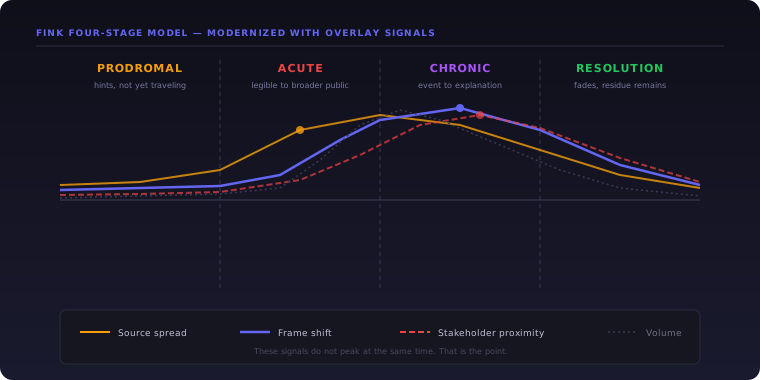
Source spread, frame shift, and stakeholder proximity do not peak at the same time. That mismatch is what the original Fink model was not designed to show.
What Fink got right, and what keeps the model alive after four decades, is the fundamental insight that crises are not events — they are processes. They have structure. They move through phases that call for different kinds of attention. A team that treats every crisis moment identically will be wrong most of the time. That contribution was real in 1986 and it is still real now.
What Fink did not anticipate — could not have anticipated — is what happens to that process under modern media conditions.
Why the original four stages break under modern media conditions
Fink wrote the model before the internet. Before social media. Before the 24-hour cable news cycle, before algorithmic amplification, before a single employee's internal Slack message could become a screenshot on Twitter within the hour.
The model assumes stages happen in sequence. One finishes, the next begins. The prodromal gives way to the acute, the acute resolves into the chronic, the chronic eventually reaches resolution. It is clean. It made sense in a media environment where stories broke on a news cycle measured in days and information traveled through a small number of editorial gates.
That is not how stories move now.
Stages overlap. A story can be simultaneously prodromal in one audience (trade press, niche forums) and acute in another (social media, consumer press). When Peloton faced safety concerns about its Tread+ in early 2021, the story was prodromal in the CPSC's safety database and acute on parenting forums at the same time. Fink's model does not have a way to represent that overlap. Most teams defaulted to "it has not broken yet" when half the story already had.
Stages reverse. A story that appears to have reached resolution can re-enter the acute phase when new information surfaces. Boeing's 737 MAX story followed this pattern over and over — each new revelation (the second crash, the internal messages, the Congressional testimony, the guilty plea in 2024) re-ignited what the model would have called a resolved crisis. Resolution is not a permanent state. It is a pause.
Stages recur. Wells Fargo's community banking scandal was not one crisis. It was a series of crises that shared a narrative thread. Each new settlement, each new regulatory finding, each new executive departure was a fresh acute phase layered on top of a chronic that never actually ended. From 2016 through at least 2020, the story was permanently in the chronic stage with periodic acute flares. Fink's model suggests a story moves forward. This one moved sideways.
The sequence myth
Platform velocity compresses everything. The prodromal-to-acute transition that once took weeks can now take hours. An early signal can go from niche forum to front-page story within a single news cycle. The model still works as a diagnostic. It does not work as a planning calendar.
How to reinterpret each crisis stage for monitoring and escalation
If the stages are real but the sequence is unreliable, the useful move is to reinterpret each stage not as a phase you pass through but as a condition you detect. What actually changes at each stage? What should you be watching? And what do teams almost always misread?
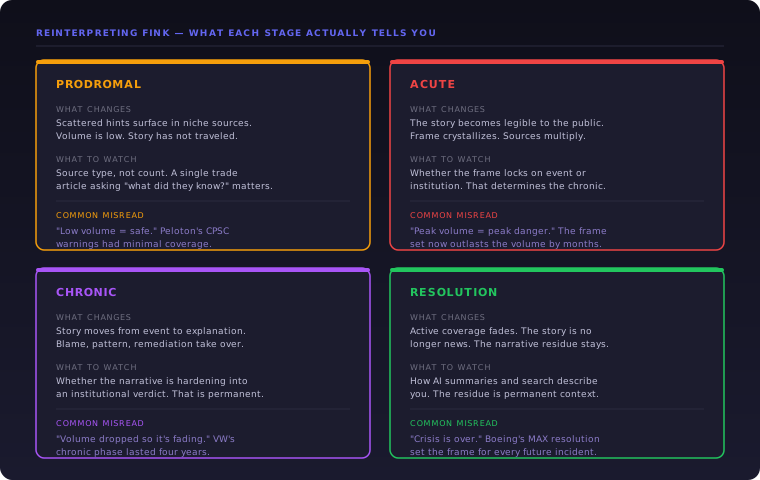
The reinterpretation turns each stage into a diagnostic question rather than a timeline position.
Prodromal, reinterpreted. The issue exists in places where your general audience is not looking. Trade publications, regulatory filings, niche communities, internal documents. The signals are there. The volume is low. The key question is not "how many mentions" but "what kind of source is carrying this, and what question is it asking." A single investigative piece asking "what did the company know" is a more dangerous prodromal signal than a hundred social media complaints.
Acute, reinterpreted. The story has become legible to the broader public. It has a name. It has a frame. It is being carried by sources that reach your stakeholders. The key question is not "is volume high" but "has the frame crystallized, and around what." A story framed around an operational failure calls for different action than a story framed around concealment — even if the volume charts look identical.
Chronic, reinterpreted. The story has moved from "what happened" to "what does it mean." This is where blame gets assigned, patterns get identified, remediation gets demanded, and institutional verdicts form — the settled public conclusion about what kind of organization you are. The key question is whether the narrative is hardening. A chronic phase where the story is diffusing into background noise is very different from a chronic phase where every new article adds another brick to the wall of institutional judgment. Volkswagen's emissions scandal spent years in the chronic phase, and each month revealed more about the scope and deliberateness of the deception. The chronic stage did not diminish the story. It completed it.
Resolution, reinterpreted. Active coverage fades but narrative residue (the permanent version of the story that lives on after coverage fades) remains. The story is no longer news. It is context. When someone searches for the company, writes an analyst report, or asks an AI tool for a summary, the chronic-phase framing is what they find. Resolution does not mean the story is gone. It means the story has become permanent background.
What actually marks the shift from prodromal to acute
This is the transition that matters most, and it is the one most teams get wrong — because they watch the wrong signal.
The standard tell for "prodromal to acute" is a volume spike. Mentions go up. The dashboard turns amber. The team gathers. But volume is a trailing indicator. By the time mentions spike, the frame has usually already set, the sources have already escalated, and the story has already acquired the shape it will carry for weeks.
The real transition is not a volume change. It is a frame change — when the question the coverage is answering shifts from "what happened" to "what does this mean about the organization."
The story shifts from describing an isolated event to implying something about the institution. "A product was recalled" is an event. "The company resisted the regulator's warning for weeks before recalling the product" is an institutional question. That is the prodromal-to-acute transition — the moment when the story starts to carry meaning about character, competence, or concealment rather than just reporting an incident.
“The organization is not a passive recipient of a crisis. Organizational actions before and during the crisis shape how stakeholders perceive the crisis and the organization.”
That is what makes the frame change so dangerous: it is not just the media deciding the story is bigger. It is the organization's own prior actions — delays, denials, resistance — becoming part of the frame. The story does not just grow. It reinterprets what came before.
Peloton's Tread+ story crossed from prodromal to acute not when the volume spiked but when the frame changed from "treadmill safety concern" to "company publicly fought the CPSC's call for a recall." That reframe turned an operational story into an integrity story. The volume followed. It always does.
This is also why sentiment analysis alone misses the transition. The language can stay calm and factual while the frame underneath it becomes dramatically more dangerous. A neutral-toned article asking "when did Boeing engineers first flag MCAS concerns internally" is more dangerous than a dozen angry tweets. The sentiment score does not know that. The frame change is the signal.
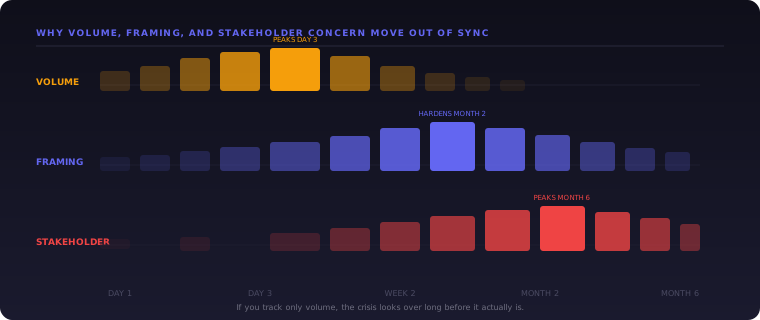
Volume peaks early and fades. Framing hardens later and persists. Stakeholder concern arrives last and stays longest. Teams watching only volume declare the crisis over while the damage is still compounding.
The practical implication for any team using Fink: stop using volume as your stage indicator. Track what the story means, who is carrying it, and which stakeholders are beginning to form opinions. Those three signals tell you which stage you are in far more reliably than a mention count.
How the chronic phase compounds reputational damage when teams stop watching
This is the stage Fink named but most teams underestimate, and it is where I see the most expensive mistakes.
The chronic phase feels quieter than the acute. Volume drops. The daily mention count goes back toward baseline. The team exhales. Leadership stops asking for updates. The war room disbands. The comms lead goes back to the day job.
And the story keeps hardening.
Boeing. The acute phases — the two crashes, the grounding, the Congressional hearings — were terrible. But the chronic phase is where the narrative became institutional verdict. The drip of internal emails, the documented timeline of what engineers knew, the pattern of regulatory capture — all of that assembled during the chronic stage. By the time Boeing pleaded guilty in 2024, the chronic phase had built the case that the acute phases merely introduced.
Wells Fargo. The acute phase was the initial 2016 settlement and John Stumpf's Congressional testimony. The chronic phase lasted years. Every new revelation — additional fake accounts, insurance overcharges, mortgage abuses — was another chapter in a story the public had already decided was about institutional corruption. The chronic stage did not fade. It accumulated.
Johnson & Johnson, by contrast, used the chronic phase of the 1982 Tylenol crisis to rebuild. The recall was the acute. The chronic was McNeil Consumer Products redesigning tamper-evident packaging, the company rebuilding consumer confidence, the case becoming a business-school example of how to use the aftermath to demonstrate institutional character. The chronic phase compounded in their favor because they understood that the story had moved from event to explanation and they shaped the explanation deliberately.
Where meaning hardens
The chronic phase is, in monitoring terms, where you need to track arc phase more than volume. Is the story fading into background noise, or is it crystallizing into a permanent institutional judgment? Those are opposite trajectories, and a volume chart cannot tell you which one you are on.
How to use Fink without letting it flatten the story
The model works best when you use it to ask the right question rather than to provide the right answer. Here is how I actually apply it.
Use Fink to name your orientation, not your plan. Saying "we are in the chronic phase" is useful if it tells the team that the story has moved from event to explanation and the response needs to shift from reactive to narrative-shaping. It is not useful if it tells the team "we are in stage three of four, so we are 75% done." You are not 75% done. You may be 20% done. The chronic phase can last years.
Use the stages to audit your response posture, not your timeline. Each stage calls for a different posture. Prodromal calls for monitoring and preparation. Acute calls for the first-90-minutes framework — classify the story type, check deviation from baseline, read the opinion structure. Chronic calls for narrative shaping and stakeholder engagement. Resolution calls for residue management and institutional memory. If your response posture does not match the stage, that mismatch is the bug.
Use source mix, framing, and stakeholder movement to determine which stage you are in — not time elapsed or volume trends. The stage is defined by what the story means now, not by how long it has been running or how many mentions it has generated. A story can jump from prodromal to chronic in 48 hours if the frame change is severe enough. It can sit in the chronic phase for four years if the narrative keeps accumulating.
Accept that you may be in multiple stages simultaneously across different audiences. The story may be acute for retail customers and chronic for regulators. It may be resolved in mainstream press and still prodromal in trade publications where a follow-on investigation is building. Fink's model is a lens per audience, not a single global state.
A simpler Monday-morning test for crisis stage judgment
If I were handing a junior team member a diagnostic for Monday morning, it would be three questions. Not Fink's four stages verbatim — those are the underlying model. These are the practical tests.
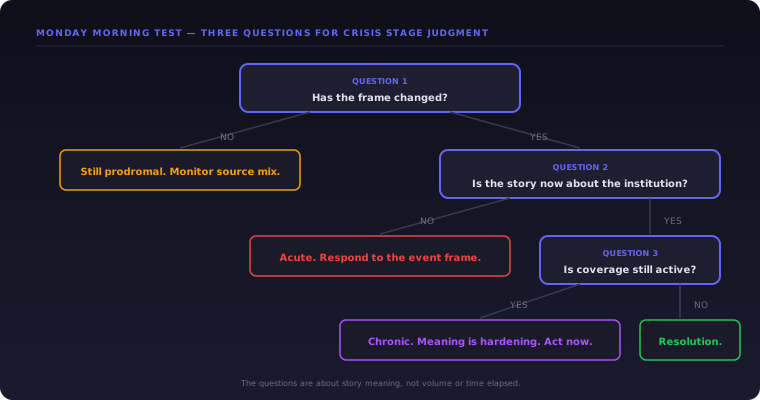
Three questions that map to Fink's stages without requiring anyone to have read the textbook.
Question one: Has the frame changed? Is the story still about an event, or has it shifted to imply something about the institution — its judgment, its integrity, its culture? If the frame has not changed, you are still prodromal. Watch source mix and wait.
Question two: Is the story now about the institution? If yes, you have crossed from acute into chronic territory. The story is no longer "what happened" but "what kind of organization lets this happen." That transition is the moment when the reputational damage starts compounding rather than accumulating.
Question three: Is coverage still active? If the story is about the institution but coverage has faded, you are in resolution. The narrative residue is now the permanent context in which future stories about your organization will be read. Manage accordingly.
Stage as meaning, not time
Those three questions do what Fink's model does — orient the team — without requiring anyone to remember which stage is which or to assume the stages arrive in order. The questions work because they track meaning, not mechanics. And meaning is what determines whether the response helps or hurts.
Fink gave communications teams a vocabulary for something they had always felt but could not name: that crises have structure, and different moments in that structure call for different responses. That contribution is worth preserving.
What I would retire is the expectation that the structure is sequential, that stages end cleanly, and that volume is the signal for transitions. The model works as a map. It does not work as a GPS. And the teams that use it best are the ones who check the map, look out the window, and adjust — rather than the ones who follow the route because the model said they should be in stage three by now.
Use Fink to orient your posture. Use source mix, frame change, and stakeholder movement to determine your actual position. Use the Monday-morning test to keep the team calibrated without the textbook. And never assume the chronic phase is the quiet part. It is often where the story becomes what it will mean forever.
Related
pillar guide
Crisis Response: A First 90 Minutes Framework
Most crisis playbooks start with a holding statement. The harder question — what kind of story is this — gets skipped. Here's a framework that doesn't.
glossary
Arc Phase in Reputation Intelligence
Arc phase is the lifecycle stage of a reputation story. The phase — not the volume — determines the stakes and the correct response.
case study
How Boeing's Narrative Shifted Before the Headlines
Boeing's 737 MAX narrative shifted from pilot error to cover-up over five months. Every transition was visible in the framing before it hit the numbers.
editorial
5 Early Signals Before a Story Breaks
Stories don't break out of nowhere. Five precursor patterns are visible 72 hours before the headline — and the dashboard is built to miss all of them.
pillar guide
Why Sentiment Analysis Fails During a Reputation Crisis
Sentiment scores tell you how language sounds, not what the story means. During a real crisis, the tone stays calm while the story underneath gets worse.